Denmark’s Route to Upgraded Banknotes
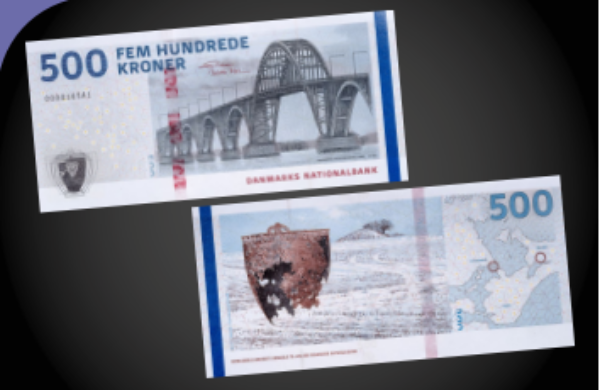
Late last year Danmarks Nationalbank began the upgrade of its banknote series with a new 500 kroner, setting the scene for more advanced security features across all its banknotes.
The upgrade was prompted not because of any deficiencies in the existing notes in terms of security, but because a necessary change to the designs caused by a change in printing processes provided the perfect opportunity to improve the security features at the same time.
The Danish krone is issued in 50, 100, 200, 500 and 1,000 denominations. The current series was introduced in 2009 and the designs are notable for their ‘Scandinavian’ style. The face of each note depicts a motif of a Danish bridge. The selected bridges represent different architectural styles and various regions of Denmark. The main motif on the reverse of each note is a prehistoric find discovered near the bridge in question.
They were printed by the Bank’s own printworks, which was one of the few in the world to do so with web – rather than sheet-fed machines. Earlier last decade, the Bank investigated updating its printworks. The investment would, however, have been substantial at a time when cash usage was declining rapidly (Denmark being one of the countries where this is happening the fastest).
So in 2014 the Bank took the decision to close its printworks (and mint as well) and to outsource note and coin production. Two years later, operations ceased and in 2018, following a public tender, the contract to produce Denmark’s banknotes was awarded to Oberthur Fiduciaire. The contract for coins, meanwhile, went to the Mint of Finland.
The reason for a new 500 kroner was not due to any issues with counterfeiting (the rate is very low in Denmark, less than 4ppm), but because the stocks of notes last printed in 2016 were running out. Due to the change in printing from web to sheet, the new notes would not be the same. So, given that a simple reprint was not an option and some changes would have to be made anyway, the Bank took the opportunity to upgrade the notes with new features.
No change to fundamentals
As the note it replaces, and indeed the whole series, was only ten years old, there was no need or indeed appetite to change the fundamentals of the design. Instead, the key objectives were to stay true to the minimalist Nordic design of the current notes; to provide a very clear visual upgrade that was not, however, too different from the current notes; and to improve machine readability.
As part of this process, five new security features were added, bringing the total number from 14 to 19. Furthermore, three of the existing features were upgraded, meaning that the 2009.
A series displays five more security features, with eight being new, compared to the existing series.
Acceptable compromise
Because the narrow width of the web fed process offers certain advantages in offset printing, and the inks were instant drying (and hence produced better fine line gratings and dots), some of the offset features (notably the prehistoric artefact on the reverse) did not offer the same detail and density in the sheet-fed version. This, however, was viewed as an acceptable and necessary compromise.
But elsewhere, the sheet fed process offered a number of advantages and new opportunities, notably through the wider range of intaglio colours which have enabled the inclusion of IR splits, magnetic inks and the replacement of the offset printed signature and Bank’s name with intaglio versions.
A see-through feature in the form of the numeral 500 has been added, and the embedded thread upgraded to an encoded machine-readable version with microtext. A new embossed tactile mark in the shape of a triangle for the visually impaired has also been added, and an iridescent stripe on the reverse.
The most obvious change is the new wide micro-optic thread. The 2009 series was one of the first in the world to feature a MOTION® thread from Crane Currency on all denominations.
In this new version, a wider RAPID® thread (5mm) has been used, in a different colour (red) and with different icons, and now appears on the front of the note for faster public authentication.
The note was introduced to the public last November, against a background of less cash usage. The Bank conducts a household survey every two years, the last of which was in 2019. Between 2017 and 2019 cash transactions fell from 23% to 16% by volume and 16% to 10% by value. For the age group 70-79 year olds, cash usage fell from 40% to 22%, showing an unusual level of confidence by this age group in paying digitally.
But, in spite of Danes being among the most tech-savvy and computer literate in the world, there remains a sector of the population (c. 10%) that does not engage with electronic communications or digital payments, so the public education campaign that accompanied the launch of the new note had to cover all bases.
Surprising public interest
This campaign included a leaflet distributed to every household, videos, information packs for the media and TV interviews. The reaction was very positive and, says the Bank, it was both pleased and surprised by the level of interest generated and the coverage, given the preference of Danes for non-cash payments.
The new 500 kroner will circulate in parallel with its predecessor. The next new notes will be introduced as and when they are needed, ie. when stocks of the current versions run out. Two denominations are already prepared, and the same design and upgrade philosophy as the 500 kroner will be applied across all the new series.
Subscriber content
Read the full article
Full access to Currency News articles, newsletters and archives.