
· 3 min read

Diversity Exemplified in G7 Banknote Denominations

Mark Spencer
Mark Spencer · Technical Product Manager, De La Rue
Diversity Exemplified in G7 Banknote Denominations

The recent meeting of the G7 (Group of Seven, an inter-governmental political forum consisting of Canada, France, Germany, Italy, Japan, the UK and the US) held in the UK prompted De La Rue to look at the banknotes of the participating countries, which threw up some interesting divergences in their approaches to banknote security. Or, to put it another way, how they illustrate the diversity that is present in the banknotes of some of the world's most advanced economies.

The importance of diversity can be overlooked when evaluating a particular security feature. However, that diversity helps to make banknotes more secure globally and helps ensure that central banks can get the specification that really meets the needs of their cash cycle.

If there was only one type of security feature to choose from then criminals would only have one target to focus on. Banknote issuing authorities wouldn’t be able to optimise their banknote series for their particular requirements (eg. durability, functionality, environmental impact, cost and security). Banknotes would all start to look similar.

Fortunately, there is choice. Public security features based on holographic, micro-optic, colour shifting and combinational technologies exist. These technologies have all progressed to produce a range of effects (from simple to highly complex) and are often available with a range of designs.

Banknote issuing authorities can layer hidden and public recognition security features throughout their banknote. They can reduce the number of features for notes that are at low risk of being counterfeited. They can put additional or bigger security features on the notes that are at higher risk of being counterfeited. They can ensure their banknotes have different security features from their neighbours or different features throughout their series, depending on their needs.

If you are a criminal it is more expensive and time-consuming to simulate banknotes with a diverse range of features because you have multiple technologies, effects, and designs that you must simulate. You must invest in multiple types of equipment, source multiple types of material and master multiple different techniques. The diversity of choice of security features makes it harder to counterfeit notes overall and reduces the chance of a criminal producing a high quality simulation.

The banknotes of G7 countries provide an excellent case study in diversity. These countries all have relatively low levels of counterfeit notes and their banknotes consist of a wide range of security features. If ever you wanted reassurance that there isn’t one ‘magic bullet’ security feature, then it is worth reviewing the specification of the banknotes in the G7 countries.

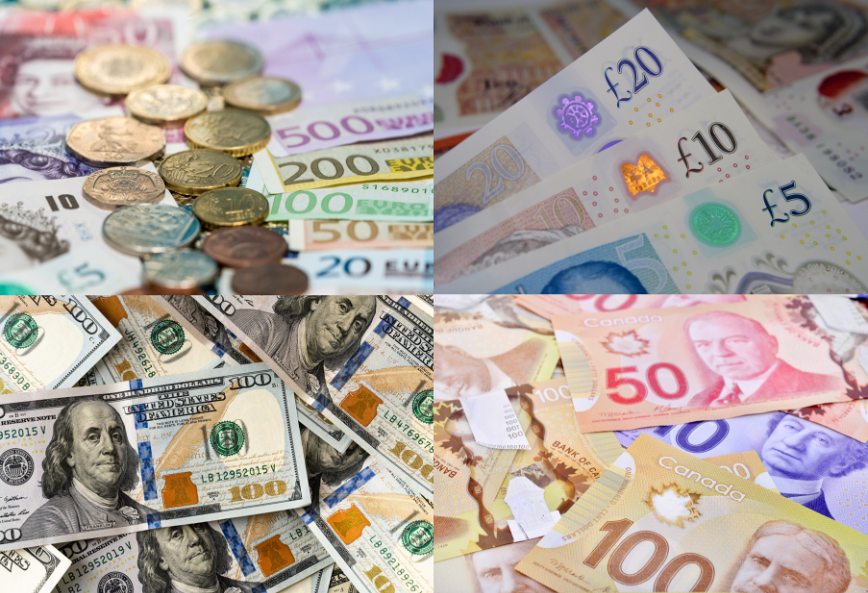
The main security features (or absence) in the currencies of the G7 members.

The first thing that is striking is that a windowed security thread only appears in one of the 25 banknote denominations, the US$100 banknote. The other 24 banknotes are secured via a combination of other features.

The Bank of Canada and Bank of England notes are the newest series and are on polymer substrate with a secure window and a holographic stripe. Euro banknotes have an embedded thread, a holographic stripe with a window and OVMI ink. The Bank of Japan has no security threads at all but secures its upper denominations with a holographic patch. The US has embedded threads in all denominations except for the $100, which has a windowed thread.

Across the set, the versatility of holograms and windows are apparent, appearing on both paper and polymer banknotes. 67% of the G7 banknotes contain some type of hologram. 12 out of the 25 contain a secure window – either as part of the paper holographic stripe or used as a secure frame around the polymer holographic stripe.

So overall the banknotes of the G7 countries highlight that there isn’t one single way to secure your banknotes. Banknotes can be optimised for durability, security, functionality, economic and environmental needs of a particular denomination in a particular cash cycle. There are systematic and frequently tested evaluation processes that are available to central banks when considering the requirements of their next new series of banknotes.

Subscriber content

Read the full article

Full access to Currency News articles, newsletters and archives.

Sign Up to Currency News Weekly

Receive regular updates on the latest news and articles posted on our website.