
· 4 min read

Environment, Cost and Social Responsibility at Heart of New Eastern Caribbean Series

Astrid Mitchell
Astrid Mitchell · Editor
Environment, Cost and Social Responsibility at Heart of New Eastern Caribbean Series

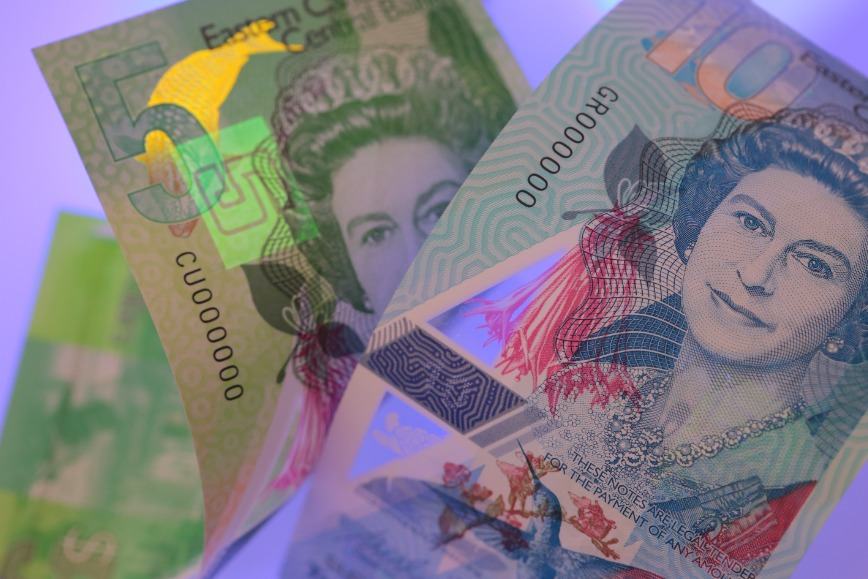
This March, the Eastern Caribbean Central Bank (ECCB) issued its new $5 polymer banknote into circulation, completing the transition of the Eastern Caribbean dollar to De La Rue’s SAFEGUARD® polymer that began in 2019. According to the ECCB, the reasons for the transition were threefold – the environment, cost, and security.

The Eastern Caribbean Central Bank (ECCB) was established in October 1983 as the monetary authority for a group of eight islands, all members of the Eastern Caribbean Currency Union – Anguilla, Antigua and Barbuda, Dominica, Grenada, Montserrat, St Kitts and Nevis, Saint Lucia, and St Vincent and the Grenadines.

Between them, the member islands comprise an archipelago, stretching in an arc from Puerto Rico in the north to Grenada in the south, and have a combined population of 630,000 and landmass of over 3,000 km².

The currency itself (code XCD) was introduced in 1965 as the successor to the West Indies dollar. Banknotes are denominated in 5, 10, 20, 50 and 100 dollars, and coins in 1, 2, 5, 10, 25 cents and 1 dollar. The new banknote series is the first major redesign in nearly 20 years, the previous series having been introduced in 2003, albeit with several upgrades over the intervening years.

Taking an environmental lead

Key to the decision of the ECCB Monetary Council to switch to polymer was the environment, according to its Governor, Timothy Antoine. The Caribbean is one of the lowest emitters of carbon dioxide in the world, he said, but one of the regions most impacted by global warming. The islands have a target of being net zero by 2022 and are well on the way to achieving this goal. The longer lifespan and lower environmental impact of polymer is part of this focus, as well as demonstrating moral authority and taking action on global warming.

The longer life of polymer also points to another reason for the switch, namely to save costs which, in terms of distribution among the eight island members, are high. A longer lifetime – 2.5-3 times that of paper – will help save on the costs of replacement, transportation and storage.

The upgrade also allows for the incorporation of advanced security features, ensuring that the ECCB fulfils its mandate of maintaining public confidence in the currency.

Some new designs, some old

As with a few other new series, including the Swiss franc ninth series and the latest Bermudian banknotes, the ECCB’s newest notes are in vertical orientation instead of the more traditional horizontal orientation.

A unique tactile emboss feature is incorporated to aid with note recognition for the blind and visually impaired. Each note contains a different shape created from raised bumps, present on the main denomination number situated on the top left of the front of the note. The $5 features a circle shape, the 10 an ‘X’, 20 a rectangle, 50 a triangle, and the 100 a square. The symbols were chosen in preference to braille, which is not widely used in the Caribbean.

According to Governor Antoine, one of the most positive – and gratifying – responses from the public to the new series was from the blind and visually-impaired community. The ECCB worked closely with the community to develop the special feature and many stated that – for the first time – they felt empowered by its inclusion. They feel they are no longer subject to fraud, nor dependent on others to transact for them, he said. Their reaction was ‘very powerful, almost emotional for us’.

The banknotes remain the same size and dimensions, all uniform regardless of denomination, as does the colour scheme to aid public recognition and acceptance of the new notes.

And, with the exception of the $50 note (which now includes a portrait of the late Hon Sir K Dwight Venner, former Governor of the ECCB on the reverse), they retain many of the design features of the previous series, but have a much fresher and more modern appearance, helped by the portrait orientation.

All denominations feature a portrait of Queen Elizabeth II on the front and a green-throated Carib, a species of hummingbird native to the region. Partly laid within and beside the smaller topmost see-through window of each banknote is a pink fuchsia tubular flower printed in gravure, with the Carib appearing to feed out of the flower.

On the reverse, each banknote features images – landmarks, landscapes and flora – representative of all members of the Eastern Caribbean Currency Union.

Colourful features provide advanced security

All denominations contain several machine detectable security features to ensure authenticity. Designed and printed by De La Rue, the company’s hide and reveal feature MASK™ is also included on all five denominations. The feature appears as a block of pattern separating the two smaller windows, with the denominational value of the note revealed as it is held up to the note.

Also present are the GEMINI™ – which transforms the image into two colours under UV light – and BLINK phosphorescent features.

The higher value denominations – the $20, $50 and $100 notes – feature a holographic foil stripe over the clear polymer window integrated within the bottom third of each note. The window incorporates animals native to the region, including a turtle and Carib hummingbird. The images move and the colours shift when the notes are tilted, and the feature turns grey or black when scanned as a deterrent to counterfeiting.

The Bank worked closely with financial institutions to ensure a smooth transition to the new notes, including the configuration of ATMs. It also produced leaflets to educate the public on the banknotes, including design updates and instructions for authentication. Similarly, various videos provide commentary on the new series and its launch, which can be found here.

Subscriber content

Read the full article

Full access to Currency News articles, newsletters and archives.

Sign Up to Currency News Weekly

Receive regular updates on the latest news and articles posted on our website.