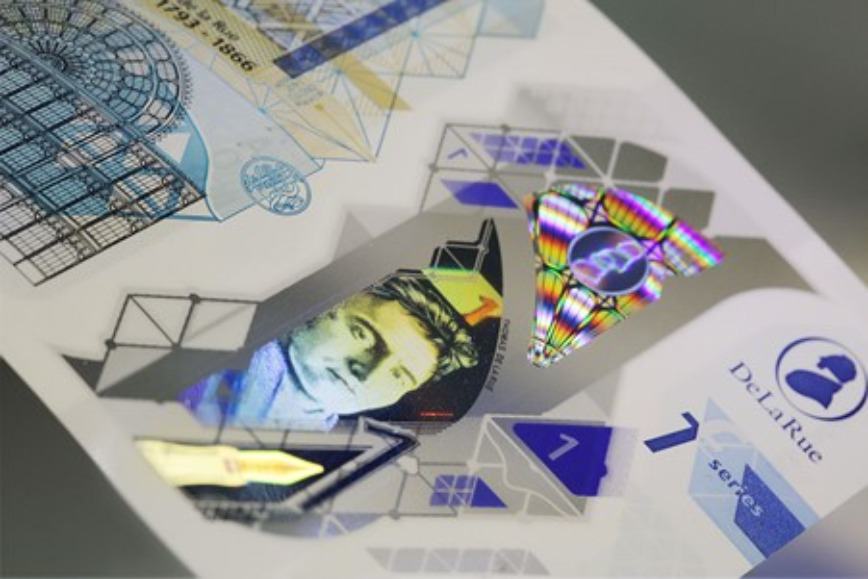
Eye-Catching, Distinctive and Secure
At the latest count a third of all banknotes contain a diffractive feature, in the form of a patch, stripe or thread, 327 to be precise. According to Frank van der Horst of the DNB in his presentation at the recently-concluded Holography Conference, the feature is the second best in public recognition terms after watermarks – which makes one wonder why the other two thirds of banknotes don’t use one!
Another speaker at the conference was Alan Newman of De La Rue, who reflected in his presentation on the importance of a layered approach throughout a banknote design, and the important role that holograms play in banknote security features mix.
The scientific definition of a hologram is the recording of an interference pattern between two coherent beams of light, one of which has been reflected or transmitted from an object. This definition is a ‘classical’ hologram.
As time has progressed the general word ‘hologram’ has evolved to become an umbrella term for a wide range of diffractive devices. Today’s banknote holograms are highly secure and advanced but, in places, their reputation has been unfairly damaged by being wrongly associated with more decorative and commercial ‘holograms.’ We therefore start by summarising the five main benefits of the secure holograms that protect banknotes today.
1. They are fully customisable – virtually any graphical element or image can be incorporated into a hologram and made secure with an effect. A spider can crawl across a web and photorealistic models of a person can be captured in full three-dimensions. Holograms can take on the form of a patch, stripe or thread to protect a banknote and demetallisation techniques enable those product formats to adopt different shapes.
2. Holographic images lose their characteristic iridescent colour upon copying. This loss of colour is unique to holograms. Many security features lose their effect upon copying but retain their colour. Holograms lose both.
3. The detailed individual images and effects used in banknote holograms are virtually impossible to simulate – because they are not used in decorative or commercial holograms. They have been designed so that they cannot be accurately re-originated using common commercially available equipment, skills or knowledge.
4. A single holographic feature protects a banknote in many ways by combining multiple contrasting effects which all require different steps to simulate. At its best a secure hologram combines effects requiring two different origination approaches because this doubles the counterfeiting barrier.
5. In polymer banknotes and paper banknotes with windows the holograms protect both sides of the note when placed in the window. Most security features only protect one side of the note, so this makes a hologram a particularly effective polymer security feature.
Getting the best ‘hologram’ for your banknote
There are different origination methods used to create the many ‘holographic’ gratings. The types of grating and the way those gratings are generated will guide the type of holographic effect that can be generated and the quality of that effect.
Figure 1 groups the various holographic origination methods by type of grating and grating generation approach. Origination methods in the same column will tend to be particularly good at specific effects, with similar strengths and weaknesses.
Fig 1: Classifications of holographic origination methods.The commercially available machines used for re-origination simulation tend to be lower resolution ‘graphic arts’ methods (low resolution contact mask lithography) or lower resolution fixed pixel origination methods (dot matrix). These methods lend themselves to simpler switching and common graphical animation effects.
Combinational technologies: digital and classical
De La Rue focusses on direct write lithography (an advanced type of digital ‘holography) and a highly evolved form of Benton (H1-H2) holography, which for convenience we simply refer to as ‘classical’ holography.. This enables holographic effects that require methods and knowledge that remain outside of the limits of standard decorative holograms. It also enables effects that are virtually impossible to re-originate convincingly using the standard commercially available machines.
Classical holograms are at the intersection of art and science, creating detailed photorealistic images, three-dimensional models, discrete animations and parallax effects that transition through every colour as the banknote is tilted. A three-dimensional owl that turns its head and winks (eg. an example of De La Rue’s TrueImage™) is most achievable through a classical holography route.
TrueImage™ OwlDirect write holography, through precise control of the grating structure, lends itself to strong and engaging kinetic effects as well as complex image switches. Intuitive, rapid movement effects that are visible over a wide viewing angle (eg. PureImage™), and interactive icons that rotate above or below the plane of the hologram whilst become sharper under focussed light (eg. SpotLight™) are examples of some of the engaging effects that are now possible.
The design philosophy of De La Rue is to use combinations of contrasting secure effects in a single note, whilst ensuring the design is memorable and intuitive. Where possible holograms combine both classical and direct write origination methods to maximise the barriers to re-origination.
The hologram is part of the overall banknote design, amplifying themes and adopting shapes that allow it to be fully integrated into the note. Holograms provide a secure solution for central banks seeking to find ways to incorporate meaningful and engaging images into their banknote designs.
Subscriber content
Read the full article
Full access to Currency News articles, newsletters and archives.