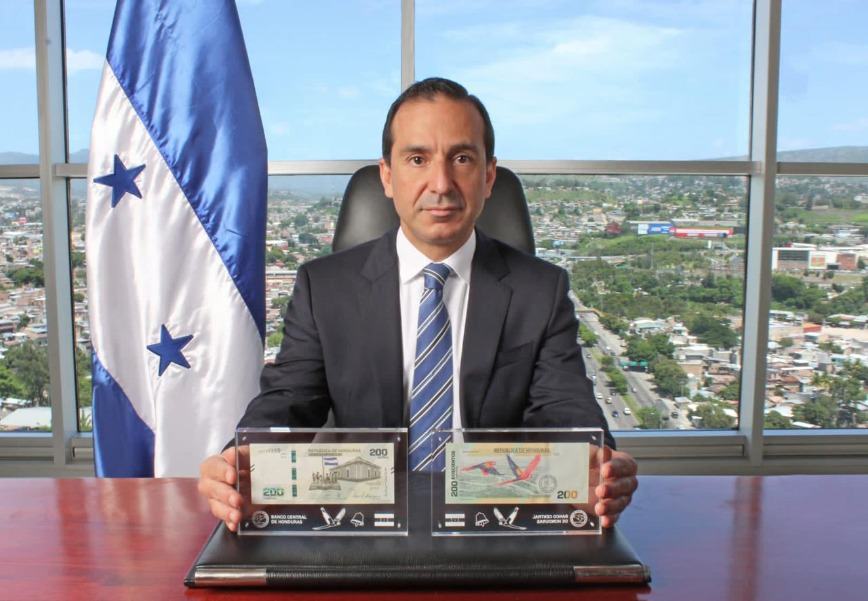
Honduran Bicentennial Banknote Celebrates Education and Environment
The Republic of Honduras is located in Central America, bordering on many countries – to the west Guatemala, to the southwest El Salvador and to the southeast Nicaragua. To the south is the Gulf of Fonseca in the Pacific Ocean, and to the north is the Caribbean Sea in the Atlantic Ocean. Its capital and largest city is Tegucigalpa. Significantly, Honduras will soon be celebrating its bicentennial alongside several other Central American countries, recognising 200 years of independence from Spanish colonisation which began in 1492 and ended in 1821.
The currency of Honduras is the lempira (HNL), introduced in 1926 to replace the peso. The lempira was named in honour of the cacique (native chief) Lenca Lempira, who is renowned in Honduran folklore as a national hero for leading the local resistance against the Spanish conquistador forces. The Central Bank of Honduras (CBH) took over production of paper money in 1950 on its foundation.
The denominations are 1, 2, 5, 10, 20, 50, 100 and 500 lempiras. Coins are denominated in 5, 10, 20 and 50 centavos. Now, to mark the long-awaited Bicentennial, the CBH will be issuing a commemorative 200 lempira banknote in September, incorporating the world`s first registered high-security Galaxy® thread.
The note was formally unveiled at the Archaeological Museum of Comayagua, which served as the country’s first government house and which was where the Declaration of Independence was received in 1821.
Innovative motifs the design
The note has design motifs that strongly reference the promotion of education, the conservation of the environment and the bicentennial of independence from the Spanish Crown.
The front of the note features education, with an image of children on an open book with a raised flag of Honduras. Education is one of the fundamental pillars for the development of the nation (expressing freedom, progress, individual and collective development), and the CBH wants to communicate this message to the community. To the right is the first Government House, headquarters of the colonial government and, as above, of the Republic itself.
Honduras is known for its rich biodiversity and natural resources, including minerals, coffee, tropical fruit, and sugar cane, as well as for its growing textiles industry.
This biodiversity is reflected on the reverse of the note, which shows two scarlet macaws, the national bird of Honduras, flying over the Biosphere of the Río Plátano. The Río Plátano Biosphere, the main natural reserve, covers around 8,300 km² in the areas of Colón, Olancho and Gracias a Dios. In 1982, it became part of the World Heritage listings of UNESCO. The protection of natural resources is of vital Importance to Honduras, to promote better living conditions and development in a sustainable manner and guaranteeing a balance between economic growth, the environment and social welfare.
World first – registered Galaxy thread
The 200 lempiras is the first banknote in the world to incorporate a registered Galaxy thread with different and precisely positioned windows. When tilting the banknote, a change can be observed in the upper and lower windows from a bell, to 200, and vice versa. The middle window incorporates an image of a parchment (a special paper pergament – pergamino) and a quill, and all three windows contain a dynamic circle that seems to move beneath the surface.
The elements in the windows are of particular significance for the Bicentennial. For example, the Bell of the City Hall of the city of Comayagua was used to call the inhabitants on 28 September 1821, and alert the authorities to a special mail that had arrived from Guatemala with the news that independence from Spain had been proclaimed on 15 September 1821.
The colourshift in the thread is from green-to-azure, matching that of the SPARK® Live feature for the main denomination numeral. The thread also incorporates some hidden security features. When looking at the banknote against the light, the hidden text BCH is observed, always positioned between the thread windows.
Additional security features in the note include a see-through feature, security fibres that fluoresce in different colours under UV light, a watermark of the parchment and quill (that also appears in the thread) with an electrotype of BCH, and two features for the visually impaired in the form of raised tactile lines and braille.
The note was produced by Giesecke+Devrient, who commented that ‘we are pleased to see the Central Bank of Honduras has successfully honoured this major milestone and has put its trust in Louisenthal’s embedded feature concept that creates unmatched security from within’.
Subscriber content
Read the full article
Full access to Currency News articles, newsletters and archives.