The Modern Omani Renaissance in Banknotes
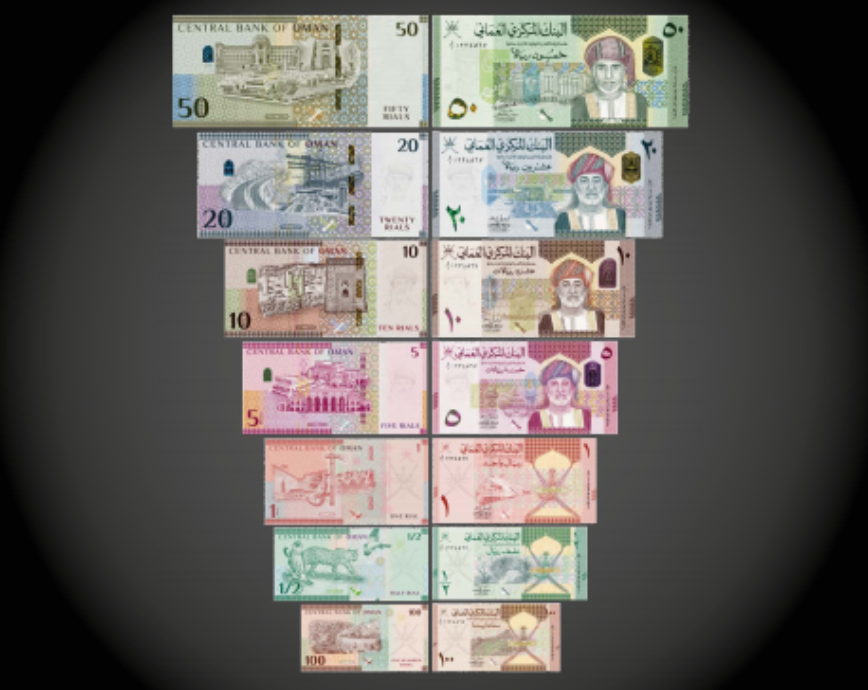
ln celebration of the 50th anniversary of the Modern Omani Renaissance, the Central Bank of Oman (CBO) has launched a new series.
Oman, officially the Sultanate of Oman, is located on the south-eastern coast of the Arabian Peninsula at the mouth of the Arabian Gulf, sharing its borders with the United Arab Emirates, Saudi Arabia and Yemen. The first national currency was introduced in 1970, replacing the Gulf rupee. Its current name, the Omani rial, was adopted in 1972. Coins were introduced earlier, in 1941.
The current series dates to 2019. Banknotes in everyday use are denominated in 100 baisa, ½, 1, 5, 10, 20 and 50 rials, and coins in 5, 10, 25, 50.
Forefront of new features
The CBO is recognised as always having been at the forefront of adopting new banknote security features – being, for example, one of the first central banks to feature a LEAD® stripe and SPARK®, and the first – in 2019 – to incorporate a varifeye® ColourChange patch in its (paper) banknotes.
In this new series the CBO is no exception, its objective being to make use of the latest technology to secure its new series against future threats, along with a wish to have different types of feature on different denominations to make each distinctive and to ensure it contains the appropriate level of security for its face value. This can be seen in the suite of new features per different notes, as well as some common to all.
The contract to design the notes was awarded to Oberthur Fiduciaire, and the production was split between it and Giesecke + Devrient. Oberthur Fiduciaire provided the substrate for the three lower denominations and Louisenthal for the four higher ones.
The 50 rial was the first issued in the series in 2020, in commemoration of modern Oman’s founder, the late Sultan Qaboos bin Said Al Said who died earlier in 2020, and whose portrait features on the front. The portrait on the front of the 20, 10 and 5 rials is of the current ruler, Sultan Haïtham bin Tariq Al Said. On the reverse of all seven notes are images grouped into specific themes of Omani life – eg. government, culture and education, transport, agriculture, religion.
The CBO has continued with the varifeye® ColourChange Patch, which is the key overt feature on the four higher denominations. An eye-catching, innovative and dynamic security solution, it comprises a foil patch with micro-mirror and optimal colour changing technology and a window. The combination provides different colours and design effects in transmission and reflection, thereby offering front-to-back (FTB) verification. In the 50 and 20 rials, the colour change is from gold-to-blue, and the 10 and 5 it changes from violet-to-green.
The four notes also feature 4mm RollingStar® security threads. In the 50 and 10 rial the colour shifts from gold-to-jade. In the 20 rial it shifts from green-to-azure, and in the 5 rial from magenta-to-green. The 50 rial thread has a crocodile effect, the 20 a double wave, the 10 a cube and the 5 a bar effect.
Furthermore, each note features SICPA SPARK® Live, with a colour shift matching the RollingStar thread.
Scaled security
The lower denomination notes – the 1 and ½ rials and 100 baisa – have a security concept which is scaled according to their individual values.
The ½ rial and 100 baisa contain an embedded 1.2mm Combifluo™ thread. This has printed text and features an alternation of fluorescent colours (yellow and blue) along the front, and an inverted alternation of the same fluorescent colours along the back of the thread, creating a third different fluorescent colour (white) in the areas of the text when the text is illuminated by a UV lamp from behind.
The 1 rial, meanwhile, is the first banknote to feature Pulsar™, a new generation of threads from Oberthur Fiduciaire that combine innovative micro-optics to create dynamic visual effects. The 4mm wide red Pulsar™ thread displays dynamic movement when the note is tilted vertically or horizontally, while the geometric patterns alternatively increase and decrease in size in a rippling ‘pop up’ effect.
All seven notes include Avalon Tri Fluo™, another first from Oberthur Fiduciaire for circulating banknotes. It is an invisible offset ink that fluoresces in two different colours (blue and pink) when illuminated under different wavelengths of UV light. When the fluorescence is gently rubbed it changes to yellow. After a short dwell time the fluorescent colour returns to its original state.
For enhanced durability, all seven notes are coated with Ultra™, a UV cured cationic post print varnish from Oberthur Fiduciaire that is reinforced with specific additives to give it additional water and oil resistant properties. These additional properties give the banknotes a higher level of protection in circulation when compared to a standard varnish.
In addition, Highlink™ has been added to the three lower denominations to further improve their performance in circulation. Highlink™ is a bulk integrated flocculated latex which is added during the paper making process and which acts as a glue within the paper structure by creating stronger bonding between the fibres. Highlink™ gives the paper increased wet strength, reduced porosity after crumpling and lower water absorption. It also increases the internal bond strength of the paper, making delamination (a preferred technique of the counterfeiter) much more difficult.
A Currency App will also be available in the near future. It will include an augmented reality (AR) quiz to familiarise the community with the series’ designs and explanation of the security features.
Subscriber content
Read the full article
Full access to Currency News articles, newsletters and archives.