
· 3 min read

Shrap Offers a Future Without Coins

Astrid Mitchell
Astrid Mitchell · Editor
Shrap Offers a Future Without Coins

At the Future of Cash conference, Chris Forero-Slee introduced his business, Shrap. As he said, he does not expect to be popular with those who make their living from or who like coins. Shrap (the company presumably takes its name from shrapnel, ie. fragments of shells or bullets but also a colloquial term for small change) is a solution that offers an alternative to coins, which they regard as a ‘pain point’ in payments.

The presentation started by considering why coins are regarded as a problem, whether for the retailer or others. For the retailer, the time they take to handle, count and manage, along with losses from the till. For central banks, the cost of the denomination for which the face value does not cover the cost of manufacture (which Chris stated was some $70 million per year for the US), the challenge of managing the cash cycle and the costs and challenges of managing coin when and if it returns.

Coins are generally regarded as inefficient to handle and count, heavy and dirty to handle and transport and difficult to manage – almost a one-way payment means, as the US and others found in the pandemic.

Having painted this gloomy picture, the presentation went on to consider on one hand the convenience, efficiency, (perceived) security and hygiene of digital payments, and on the other the loss of privacy, the risk of exclusion and people not managing their budgets that it brings.

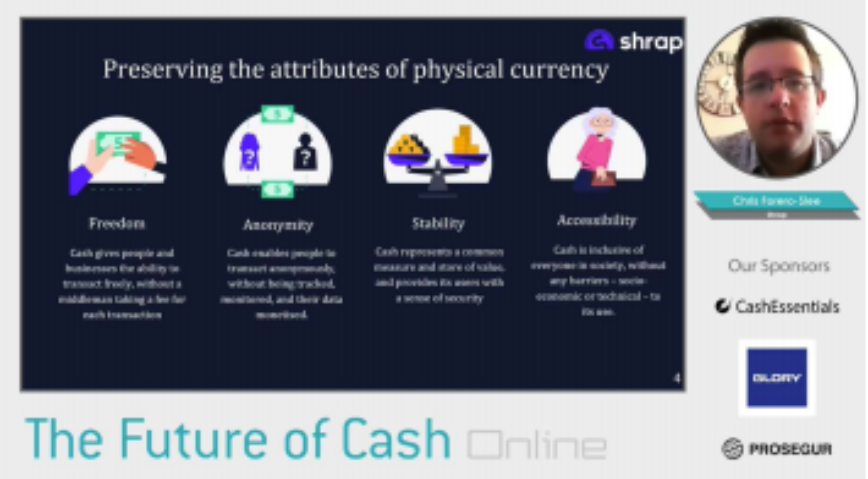
But he posited that for a substantial minority of consumers, digital payments are not a ‘win’. If cash is used less, whatever replaces it must work for all, people must be free to choose the freedom of paying without a middleman (and their fees), anonymously, with the stability that comes from a sense of security and with something that is accessible to all.

Shrap’s solution – described as a hybrid app/card-based replacement for coins – suggests a route to a ‘coinless’, rather than a cashless, society. It enables users to spend in cash but instead of receiving physical coin as change, they receive their change electronically and instantly in Shrap. Participating retailers set up a digital float, which is directly debited when change is issued.

In other words, you pay for your purchase and the change goes into a ‘wallet’ that carries the value. Lose the wallet, lose the value. The wallet, which could be on your phone, but could also be a ‘Shrap card’, allows you to use the coin value on it to pay or to transfer to another wallet or even into your bank account. Apart from the last of these, there is no fee to do this.

South Korea’s coinless initiative

This isn’t the first such initiative to replace coins. In 2017, the Bank of Korea initiated a pilot among 36,000 convenience stores, as part of its ‘Payment System Policy Roadmap – Vision 2020, enabling customers to receive small change in the form of top-ups onto pre-paid cards. The objective was to ‘ease the inconvenience of using and carrying coins and reduce the social costs incurred in their circulation and management’.

The pilot was the first of its kind in the world. Despite the results of a survey prior to the pilot, in which the majority of respondents said they did not like receiving coin as change, the response to the pilot itself among the public was lukewarm. That response notwithstanding, the Bank continued with the programme, expanding it to major retailers in the country in 2020, but also allowing change to be credited to consumers, bank accounts, rather than just prepaid cards.

At that time, the Bank stated that the ‘change deposit service’ had been used in over 30 million purchases since its launch.

Subscriber content

Read the full article

Full access to Currency News articles, newsletters and archives.

Sign Up to Currency News Weekly

Receive regular updates on the latest news and articles posted on our website.