
· 4 min read

The Risks Around Generic Security Features


Kerre Corbin
Kerre Corbin · Counterfeit Specialist
The Risks Around Generic Security Features

One increasingly common counterfeit technique is harvesting – the act of taking a security feature from a lower value object and incorporating it into a counterfeit banknote of higher value. There are several ways to minimise harvesting, including making each security feature bespoke.

Simple security threads for lower value denominations can be made bespoke with the incorporation of denomination specific letters, numbers and symbols. They also have protection from the inherent security that comes from being embedded in the paper – any attempts to remove a thread and use with a higher value banknote can typically be seen upon closer inspection.
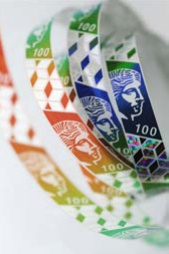
Resilience through customisation

For higher value banknotes it enhances the resilience of the security thread if the custom nature of the thread is more obvious. This may include the incorporation of bespoke images into the thread or ensuring the effects follow the contours of a unique symbol that is relevant to the banknote denomination (for instance a star shape that expands or contracts).

In De La Rue the micro-optic embedded stripe NEXUS™ is supplied for higher value denominations only so that it isn’t readily available on low value denominations. It is often sensible for banknote issuing authorities is to select features for higher value banknote denominations that are differentiated from lower value denominations.

Having different technologies and effects on a note also increases the counterfeit resilience by increasing the processes, effort and materials required.

For applied and printed features, the banknote design helps mitigate the threat of harvesting. Print layers can be designed to link with the feature, so that any harvesting attempt requires lining up very precise detail in the counterfeit note. For polymer banknotes the intricate design of the window frame also has a role to play.

Personalised shapes and demetallisation can be used to make a unique outline for each banknote denomination. These features additionally tend to be larger area features, enabling unique and highly personalised effects, for instance a three-dimensional portrait of a person that is specific to that denomination. The denominational values can be incorporated into the effects to be obviously associated with that denomination. Design can be used to protect individual banknotes, especially where it supports a simple, obvious and easy-to-remember public education message.

Sourcing from commercial market

When considering counterfeiting, one of the questions commonly asked is ‘can this effect be easily sourced from the commercial market?’

Security features should possess a unique effect that can be precisely described. It’s not enough that ‘something’ moves – a denominational value needs to expand when tilted, the colour needs to switch in the logo of the central bank or you need to see clouds that appear to move behind an object when the banknote is tilted. Best practice is to avoid generic effects, such as those that could be generated by cutting out shapes from giftwrap.

Customisation is key to avoid the generic effects of commercially-available products such as giftwrap.

In the currency industry there has been an ongoing natural concern about security technologies also being used in non-currency industries or applications. The identity space is typically also highly secure but in the brand protection space certain features and effects can be used more for decorative effect than for security.

Yet, during decades of analysis of counterfeit banknotes, it is very rare to see brand protection labels repurposed for currency. It is likely that the best practice described above, the high quality of currency holograms and the common use of obvious company logos in brand protection means that any attempt to harvest brand protection labels to use on currency are likely to stand out as being obviously different to that of the banknote security feature.

In the micro-optics space, meanwhile, the labels tend to be too thick to attempt to embed convincingly, and this thickness becomes noticeable when they are stuck on.

Best practice for holographics and micro-optics

To date most brand protection labels have been holographic, but in recent years a few micro-optic effects have started to be used. The best practice advice holds here as well – incorporating micro-optic effects that are embedded into the paper or are a bespoke shape if applied and have describable effects (ie. not just some generic movement associated with abstract movement) will help to mitigate any harvesting effect here as well.

Perhaps as important as the individual security features is the layering of the security throughout the entire banknote design. If a counterfeiter ‘simply’ has to focus on one security feature and the aesthetics of the note, then the resilience of the note is lower than for banknotes with multiple types and levels of security features.

Combining good banknote and security feature design, whilst minimising generic effects and considering how the higher value denominations can’t be copied by harvesting similar security features from low value denominations in circulation (either of the local currency or another issuing authorities currency), helps to ensure that banknotes remain resilient against the threat of harvesting.

Subscriber content

Read the full article

Full access to Currency News articles, newsletters and archives.

Sign Up to Currency News Weekly

Receive regular updates on the latest news and articles posted on our website.