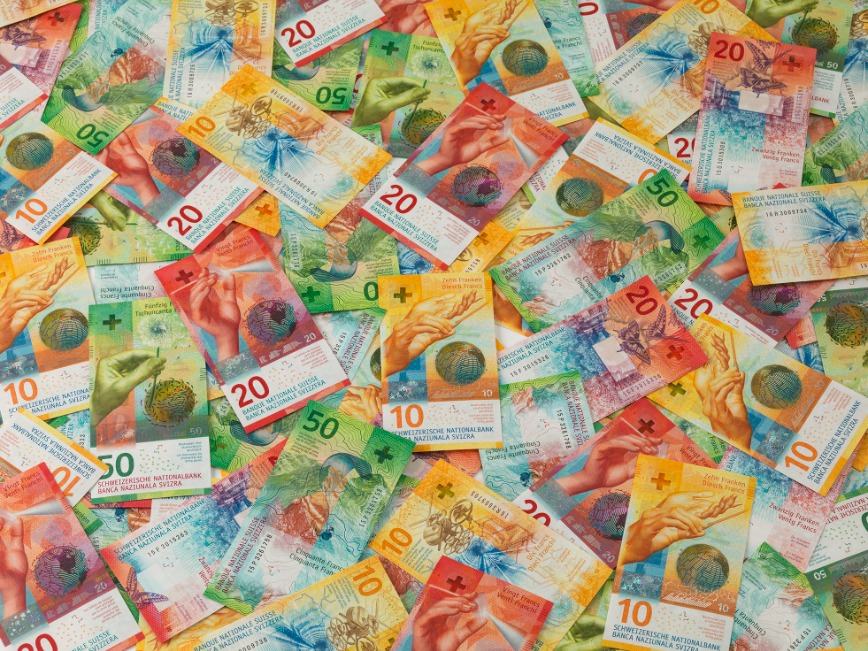
Environmental Impact of New Swiss Banknote Series – Complexity Offsets Savings
The Swiss National Bank (SNB) has conducted a Life Cycle Analysis (LCA) on its 9th series of banknotes. The study looked only at those elements of the life cycle directly under the control of the SNB, the manufacture, wholesale distribution and disposal of notes.
The key findings were that the average quantity of notes produced each year was down 30% compared with the 8th series, while the Environmental Impact Points (EIP) were down 19%.
In 2021 the value and volume of banknotes in circulation increased 4.5% and 3.6% respectively. Despite that, because the 9th series is more mechanically durable and due to fewer banknotes being used in circulation, the average quantity produced is down from 115 million for the 8th series to 80 million for the 9th.
What was included in the study
The local distribution and use of banknotes in circulation were not included in the LCA. The five areas that were included were:
Raw materials: cotton and polymer used in the Durasafe® product from Landqart.
Semi-finished products: Durasafe from Landqart, inks from SICPA and foils from KURZ.
Printing: Orell Füssli Security Printing: seven print, one application and one perforation process.
Logistics: the distribution and redemption of banknotes from the Berne and Zurich SNB offices and 13 cantonal branch agencies. In 2021, 279 million notes were issued and 268.7 million were redeemed.
Disposal: the incineration of shredded banknotes with thermal and electricity recovery.
Methodology
The LCA looked at the environmental impact of the average quantity of banknotes produced each year using the ecological scarcity weighting method published in 2013 by the Federal Office for the Environment. This looks at key indicators such as the impact on the climate, environmental acidification and the use of resources to give EIPs.
The key drivers of impact for banknotes are the quantity of material used, determined by the weight of the substrate and the waste incurred at every stage of production, the material used, the proportion of renewable energy used in the power mix and the lifespan of the notes. The cotton used in Durasafe, used to create the two outside layers of the substrate, has a lower impact than polymer used to create the inner core of Durasafe.
The SNB also looked at the Green House Gas (GHG) emissions created by the five areas considered in the study. The SNB has offset unavoidable emissions since 2011 and so has been carbon neutral as a result. It continues though, to target reductions in GHG emissions.
Results
The CO2e result is 0.003% of total Swiss emissions, equivalent to the emissions of a village of 300 people.
The SNB also compared the results of the 8th and 9th series measured in millions of EIPs.
The reduction in SNB logistics is due to improvements in processes and a change to renewable energy sources. Orell Füssli and some of the semi-finished product suppliers also switched their electricity supply to renewable energy sources.
The increases in semi-finished products and raw material scores reflects the increased complexity of producing the 9th series on Durasafe compared with the 8th on cotton. The 30% reduction in the number of notes needed each year combined with the significantly enhanced security of the 9th series offsets this increased complexity.
This LCA gives the SNB the benchmark it needs to continue its work reducing further both the EIP and GHG emission scores for Swiss banknotes.
Subscriber content
Read the full article
Full access to Currency News articles, newsletters and archives.