
· 4 min read

Uzbekistan – Great Silk Road Reflected in Designs and Threads

Astrid Mitchell
Astrid Mitchell · Editor
Uzbekistan – Great Silk Road Reflected in Designs and Threads

The Central Bank of Uzbekistan issued a new series last year, based on the theme of the ‘Great Silk Road’ – the network of trade routes dating from the 2nd century BCE until the 15th century, which played a central role in facilitating economic, cultural, political, and religious interactions between the East and West. Tashkent, the capital of Uzbekistan, was one of its major trading centres.

The design theme of the series, which combines geometric modern style with antiquity, is based on significant architectural landmarks and traditions along Uzbekistan’s section of the Silk Road. They are not only redolent of this historic trading route but include – for the three highest denominations – the latest technologies in security threads (fittingly, for a country still renowned for the quality of its textiles and silks) including, for the top denomination, the first use of RollingStar® i+.

The Republic of Uzbekistan is located in Central Asia and is surrounded by Kazakhstan, Turkmenistan, Afghanistan, Tajikistan and Kyrgyzstan. It achieved independence from the Soviet Union in 1991, when the Central Bank of Uzbekistan was found, but continued using a localised version of the Russian rouble until the national currency, the som, was introduced in 1993 (the word som means ‘pure’ in many Turkik languages, and implies pure gold) The first banknotes were issued 1993 in 12 denominations ranging from 1 to 10,000 soms. All shared the same somewhat rudimentary design – the coat of arms of Uzbekistan on the front and the madrasahs on Registan Square in Samarkand on the reverse, the only distinguishing features being the colour and denomination numeral. More sophisticated versions were introduced from 1994 onwards. The earlier high denominations were phased out, but from 2013 new high denominations were introduced in response to inflation.

The new series is denominated in 2,000, 5,000, 10,000, 20,000, 50,000 and 100,000 soms. All are replacements for existing denominations bar the 2,000 som, which is new. All were produced by the state printer and papermaker Davlat Belgisi on varnished paper.

The first two notes in the series to be issued, in June 2021, were the 2,000 and 20,000 soms. The 2,000 som features OVI®, a latent image, and new tactile feature for the visually impaired, but no security thread. The 20,000 som incorporates a 3mm wide BREEZE™ micro-optic thread from Crane Currency (one of the first banknotes to do so), engineered specifically for high use denominations. Both incorporate a watermark of a camel and the denomination numeral in electrotypes.

The new 5,000 and 10,000 som banknotes followed last September. Both incorporate a narrow metallised thread with Cleartext.

The introduction of the new series concluded in December with the two high denominations – the 50,000 and 100,00 soms.

The 50,000 som features images of the architectural monument Al-Hakim At-Termizy Maqbarasi, dating back to the 11th-12th centuries, on the front, and the ancient archaeological site Fayoztepa Artzeglogiya Yodgorligi, dating to the 1st-7th centuries on the reverse, both located in the Surkhandarya region.

It also includes a 3mm wide IGNITE® security thread from De La Rue, with the ‘Drive’ effect, one of the first applications for the new feature, which combines sharp colour change with pulsing or movement effects. The blue-to-green colour shift matches that of the SPARK® Live patch in the shape of a dove on the reverse.

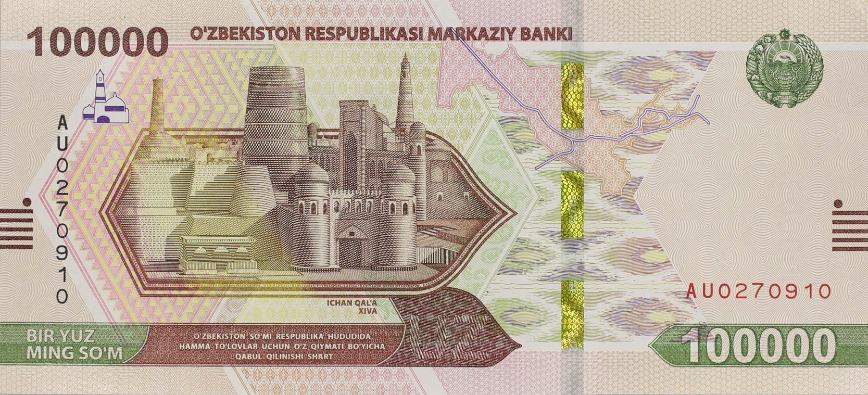
The new 100,000, meanwhile, is the first banknote in the world to feature Louisenthal’s new RollingStar i+ thread.

The front side depicts the Historic Ichan-Kala Museum in Khiva, Khorezm Province, along with the RollingStar® i+ thread with a dynamic Wave effect. It is a 4mm metallised, machine-readable thread with a green-to-gold colour shift, and features the text ‘UZB’. This, too, matches the colour shift of the SPARK Live feature on the reverse of the note, in the shape of a national ornament.

The reverse side of the banknote depicts the Angka Kala Castle, dating back to the 3rd and 4th centuries and former capital of the ancient state of Khorezm.

Louisenthal first launched security threads relying on a combination of micromirrors and colour shift in 2011 with the launch of RollingStar®. Today, over 100 denominations worldwide have successfully integrated RollingStar® threads. With RollingStar® i+, Louisenthal sought to drive the success of these threads even further.

The micromirror-based security platform has undergone extensive research and simulations, to determine the critical parameters for improving the dynamics and brilliance. By optimising the mirror layout, scattering was suppressed, and thus increased the intensity of the reflected light. The development of new manufacturing techniques, meanwhile, have enabled amplified dynamics, opening the door for effects offering superior visual recognition and design-integrability. In particular, smaller and detailed textures can be generated, to add to the main vibrant effect.

Additionally, facilitating automated banknote processing, RollingStar i+ supports level two magnetic technologies, including MultiCode®.

While the new series is now complete, earlier this year at a press conference, the Governor of the Bank announced that a new high denomination 200,000 som banknote will be issued in 2024.

Subscriber content

Read the full article

Full access to Currency News articles, newsletters and archives.

Sign Up to Currency News Weekly

Receive regular updates on the latest news and articles posted on our website.