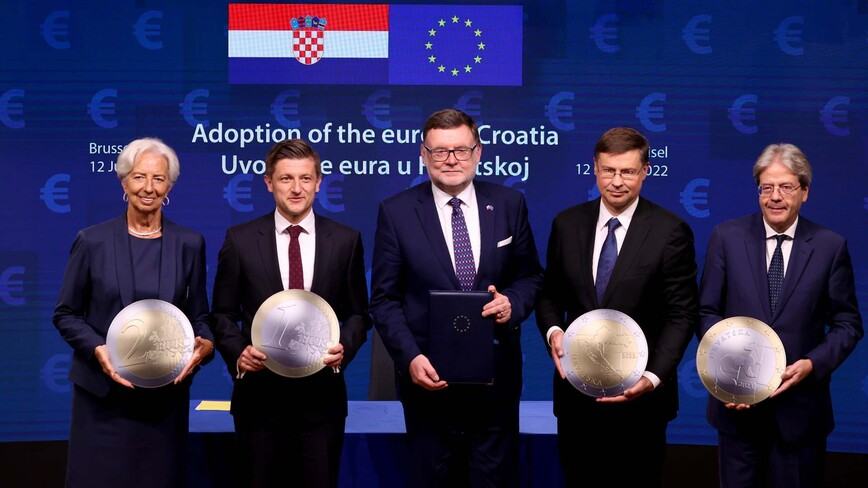
Croatia Gets Green Light to Adopt Euro in 2023
It’s official – Croatia has been given the green light to adopt the euro as its currency. On 12 July the Council of the European Union formally approved its accession to the euro area on 1 January 2023, determining a Croatian kuna conversion rate of 7.53450 per euro.
The final thumbs-up makes Croatia the first newcomer since Lithuania in 2015. Its accession brings the number of members to 20. This will rise to 21 in January 2024 if Bulgaria gets the go-ahead too. The Croatian population is 4 million, and GDP per capita was €17,000 in 2021, half that of the euro-wide average.
Work had already started to prepare for the transition, based on the National Euro Changeover Plan which was adopted in December 2020.
One of the steps will be adapting the country’s 4,700 ATMs. Euro notes are a different size from the kuna, meaning that most ATM cassettes need adaptation or replacement.
There is also the challenge of being able to provide kuna banknotes up to the point of changeover, including during the busy Christmas and New Year shopping and holiday season. The decision when to make the change, before or after 1 January, will be made by the ATM owners and will depend on the regional coverage and the frequency of use of the ATMs. Some ATMs are able to issue kuna or euros with just a software change but most will require an engineer to visit them.
A period of dual display of prices will begin on the first Monday in September and end at the end of December 2023. The supply of banknotes and coins in advance of the launch (so-called frontloading) will also begin in September. It will be possible to pay with either kuna or euros for the first two weeks of 2023, although all change will be given in euros.
36 billion kuna (€4.8 billion) is in circulation and the CNB is expecting about 270 million notes to be returned. Although people will be able to exchange kuna banknotes for euros for an unlimited period, and three years for coins, in other countries experience shows that people tend to exchange the vast majority of their legacy currency extremely quickly.
The Croatian National Bank estimates the cost of switching to the euro will be 916 million kuna (€121 million), along with 800 million kuna for its euro banknotes, which will be loaned from European Central Bank stocks.
The coins will be produced by the Croatian Mint, and production has now started, the designs having been finalised last year. The €2 features a map of the country and the €1 a marten (or kuna in Croatia, after which the currency was named). The 50, 20 and 10 cents feature a portrait of the inventor Nikolas Tesla, and the 5, 2 and 1 cents an image of the Glagolitic script (the oldest known Slavic alphabet). The coins also feature a checkerboard, part of Croatia’s national coat of arms.
More than 1 billion lipa and kuna coins (spread over nine denominations) will need to be withdrawn, enough to fill 260 trucks. They will be stored by the Ministry of Defence at a secret location for three years. Kuna banknotes, however, will be destroyed when they are returned.
Subscriber content
Read the full article
Full access to Currency News articles, newsletters and archives.