
· 4 min read

The End of the Line for Banknotes in Pakistan

Astrid Mitchell
Astrid Mitchell · Editor
The End of the Line for Banknotes in Pakistan

In the November 2021 issue of Currency News™, we ran an article on a research project by Pakistan Security Printing Corporation (PSPC) to evaluate the parameters for composting waste from banknote production by mixing it with manure. This time it’s the turn of the State Bank of Pakistan (SBP), and what it does in terms of dealing with banknotes at the end of their life.

SPB is located in Karachi and has a number of subsidiaries, including SBP Banking Services Corporation (SBP-BSC), which forms the operational arm of SBP and has 16 offices in 15 cities across Pakistan, and the banknote production division PSPC. The latter is the majority shareholder in Security Papers Limited, the country’s own high security (banknote) paper production facility and has a joint venture, SICPA Pakistan, with SICPA for security inks.

Currently all banknotes in circulation are printed on cotton substrate. There were plans to trial polymer on two commemorative banknotes to mark the 75th anniversary of Pakistan (in 2022) and the SBP (in 2023) respectively, albeit that these plans have been shelved and the notes are being produced on paper instead.

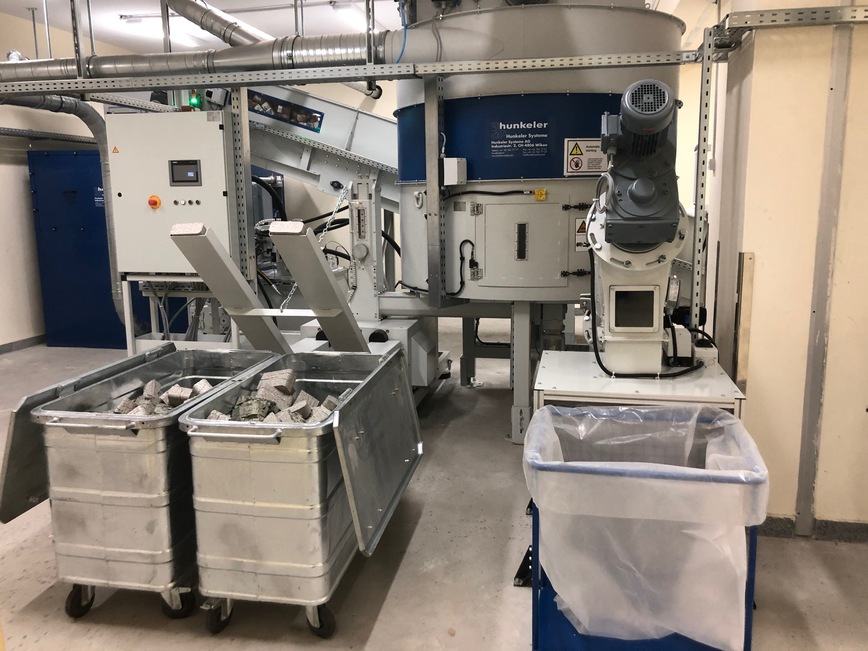
SBP destroys production residues from banknote production at its headquarters in Karachi as well as unfit notes withdrawn from circulation, using shredding technology from the Swiss destruction equipment specialist Hunkeler Systeme.

The dedicated processing/destruction facility is equipped with 11 BPS M7 high speed processing systems from Giesecke+Devrient and seven banknote destruction systems (BDS), four from Hunkeler and three from G+D. All of G+D’s BDS are connected to the M7 sorters, as are the Hunkeler systems with the exception of one, which operates off-line.

According to Salman Malik, Deputy Director for the Project Management & Cash Technologies Unit, in the Currency Management Department of the SBP-BSC, the BDS machines destroy 1.5-2 million notes per day. The total annual disintegration capacity of the Bank has now reached approx. 2.5 billion pieces of lower denomination banknotes (Rs100 and below).

As part of its Currency Automation Strategy (CAS) launched in 2016, the Bank has been investing in new processing and destruction equipment which is now in the final phase of installation. As a result of automation, the number of soiled banknotes destroyed has increased by 64%.

Hunkeler’s disintegration systems have a maximum offline destruction capacity of 300 kgs per hour. SBP BSC is currently running on a single (8-hour) shift. After the shredding process, the banknote shreds are processed together with the online shredded banknotes into briquettes (units can compress up to 400 kgs per hour) which are then sold to private contractors to be disposed of.

It is not known how they are disposed of, other than that the options do not include incineration since, says Mr Malik, this is not environmentally friendly. An exercise was carried out in collaboration with Pakistan Council of Scientific and Industrial Research (PCSIR) to explore the feasibility of burning briquettes of shredded notes. Although these briquettes burn with higher energy (BTU) compared to other materials (wood, coal etc.) of the same mass, due to the high sulphur content in the notes (primarily due to the inks), the study concluded that it is not advisable to burn them due to the adverse environmental impacts.

Hunkeler’s systems were introduced from February 2019 onwards. The company worked with local partners who provided engineers and electricians on site. The instalment phase was supported by monthly meetings and exchanges via a dedicated WhatsApp group, enabling operational acceptance to take place even during COVID.

Since installation was completed, 95% of total equipment uptime has been exceeded says Hunkeler, and Mr Malik commented that software adaptations needed as part of the set-up for the new installations were made very quickly by the company.

Added to this, the Hunkeler Process-Flow Software Solution, Control Manager (CM), has met the requirements of SBP BSC to a high degree, said Malik. CM records the entire destruction process, with every action recorded in a protocol and followed individually, if needed. All relevant actual and historical information and the current operational condition of the shredding system are clearly displayed on a dashboard. The CM consolidates the data from each system and uploads the files to the Bank’s core banking system, from which real-time reports measuring volumes and performance can be retrieved immediately.

Whilst the Hunkeler destruction equipment at the SBP is currently shredding paper notes only, it does have the advantage that polymer and composite materials can also be destroyed on-line or as a separated process without any need for additional equipment, should Pakistan decide to introduce polymer notes in the future.

Subscriber content

Read the full article

Full access to Currency News articles, newsletters and archives.

Sign Up to Currency News Weekly

Receive regular updates on the latest news and articles posted on our website.