Bahamas New Series – a Case Study for Successful Feature/Substrate Pairings
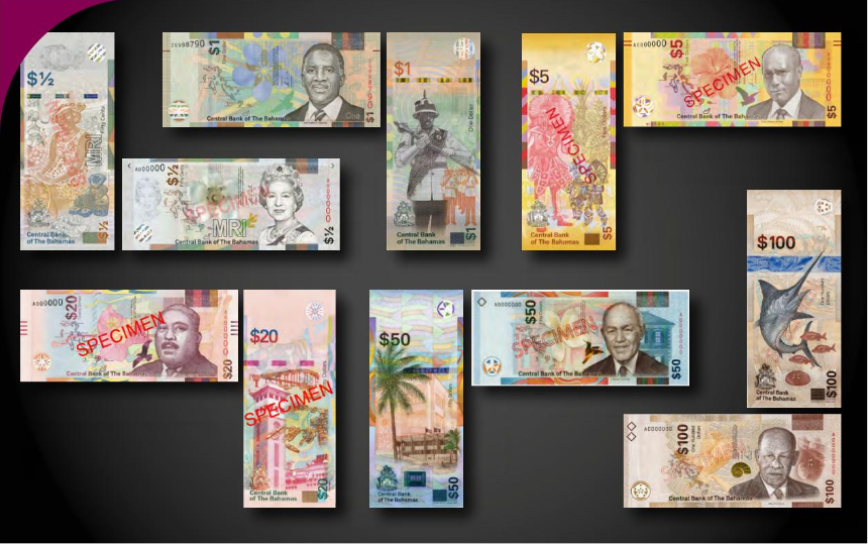
In October 2021, the Central Bank of the Bahamas (CBB) released its new $100 banknote, completing the roll-out of its CRISP (Counterfeit Resistant Integrated Security Product) Evolution series which it began back in 2016.
The new series of banknotes is – as the name suggests – an evolution of the original CRISP series first introduced in 2005, and is remarkable both for incorporating a broad cross-section of substrates, printers and features, and for its introduction of multiple firsts for feature-substrate pairings.
The Bahamas is an archipelagic state in the Caribbean consisting of around 700 islands, 16 of which are major islands, surrounded by hundreds of thousands of kilometres of ocean space. To reflect the size and diversity of the Bahamas, the new banknote series contains colourful portraits, a number of different features, and is printed on a variety of substrates.
The Bahamian dollar, which is pegged to the US dollar, was introduced in 1966, seven years before the Bahamas gained independence, and replaced the pound. The currency has undergone several revisions over the years, but has maintained its original structure of eight denominations, ranging from $½ to $100 notes.
The first banknote of the new series was the $10 in 2016. The new paper note was designed and printed by De La Rue in collaboration with the CBB, and was the first circulating banknote to include its Active™ security thread, which uses lenticular technology and microscopic fine line printing to deliver a clear switching effect with image changes.
The design of the note included Sir Stafford Sands, the former finance minister. The CBB accompanied the launch with a publicity campaign, including a film explaining the features of the new banknote.
Last summer, Crane Currency was awarded the tender for the reprinting of the $10, making it the company’s first contract with the CBB. Besides the reprinting, the banknote also underwent a security upgrade with the addition of a RAPID® Detect 4mm micro-optic security thread (also used in the new $50 banknote) and a revamped colour scheme.
The second note in the new series, in Autumn 2017, was the $1, which was printed on Louisenthal’s Hybrid™ substrate. At the Intergraf High Security Conference in 2019, Deputy Governor Derek Rolle was able to demonstrate that the $1 lifetime in circulation had increased from 13 months to 22 months.
The note also features Louisenthal’s RollingStar® security thread on the reverse, five colour intaglio on both sides, and includes an updated portrait of the first Prime Minister, Sir Lynden O Pindling, which was also used for the watermark.
The design on the note’s reverse includes a drum major in full regalia leading the Royal Bahamas Police Force’s marching band. As with all other new banknotes in the series, the reverse was designed in vertical orientation, with a vertical iridescent band incorporating a motif of a snake, the letters CBB and the denominational value appearing also.
In Autumn 2018 the new $20 was issued, featuring a portrait of the late Sir Milo B Butler, the country’s first Governor General, on the front, and the tower at Festival Place, overlooking Nassau Harbour, on the reverse. As with the original $10 CRISP Evolution, the note was designed and printed by De La Rue and features its Active® security thread.
In 2019, the new $½ introduced an updated design with the previous banknote not included as part of the original CRISP series. The front features a portrait of HM Queen Elizabeth II and a replica map of the islands of the Bahamas, with an image of a strongback flower in the centre. The reverse features a vignette of Sister Sarah, a prominent figure of the Straw Market in Nassau.
The introduction of the Evolution series $3 note later in the year marked the first complete redesign of this banknote since 1984. As with the $½, the note features a portrait of HM Queen Elizabeth II on the front and sailing boats on the reverse. Security features include OVI®, a colour shifting thread, a watermark of the Queen with an electrotype of the denomination numeral, and an iridescent stripe.
The $50 was the sixth banknote – and third in 2019 – of the new series to be introduced. Produced on Landqart’s Durasafe® substrate, it was the first note in the world to integrate a RAPID® thread into the composite substrate. Other features include a see-through window in which a replica of a window from the Parliament building can be viewed, a mould-made watermark with electrotype, SPARK® and, on the reverse an iridescent stripe.
It features a portrait of Sir Roland T Symonette, the first Premier of the Bahamas following self-government, and an image of a blooming ‘frangipani’ flower on the front, with the reverse featuring a vignette depicting a rendering of the CBB.
The penultimate banknote of the new series, the $5, entered circulation in September 2020. As with the $1, the banknote is printed on Louisenthal’s Hybrid™ substrate and features the company’s RollingStar® security thread as one of the key security features.
The front of the note displays a portrait of Sir Cecil Wallace-Whitfield, a prominent politician who was posthumously conferred with the Order of National Hero. The reverse features a vignette depicting Bahamian artist Delton Barrett’s likeness of a Junkanoo cowbeller in full costume. The bright colours of the banknote highlight the liveliness of the annual celebrations of the Junkanoo Festival, which have been evolving in the Bahamas since the early 1900s.
As noted in the introduction of this article, the eighth and final banknote of the new series – the $100 – was launched in October last year. Printed by the Canadian Bank Note Company on Durasafe substrate, it features a MOTION® Surface stripe from Crane, another first for the combination of the two technologies. The security stripe on the reverse depicts a large water drop, with a three-dimensional image of fish swimming that can be seen when the note is tilted.
The front of the banknote features a portrait of the late Arthur D Hanna, the eighth Governor General, and a Royal Poinciana flower. The reverse features a blue marlin in the foreground, surrounded by other depictions of marine life such as coral.
As part of its public education campaign, in 2017 the CBB launched a CRISP Evolution Training Tool on its website including an online tour. Users can select denominations from the new banknote series and see the various security features used in the designs. The CBB has also published a video and explanatory leaflet to demonstrate the features of each new banknote.
To coincide with the launch of the new $20, the Bank released a banknote app which includes detailed tutorials on the key security features of each new banknote. As new notes were introduced the app was updated, with the second iteration of the app released to coincide with that of the new $5 banknote.
Subscriber content
Read the full article
Full access to Currency News articles, newsletters and archives.