
· 4 min read

New Look, More Security for the Latest in a Long Line of Tunisian Banknotes

Astrid Mitchell
Astrid Mitchell · Editor
New Look, More Security for the Latest in a Long Line of Tunisian Banknotes

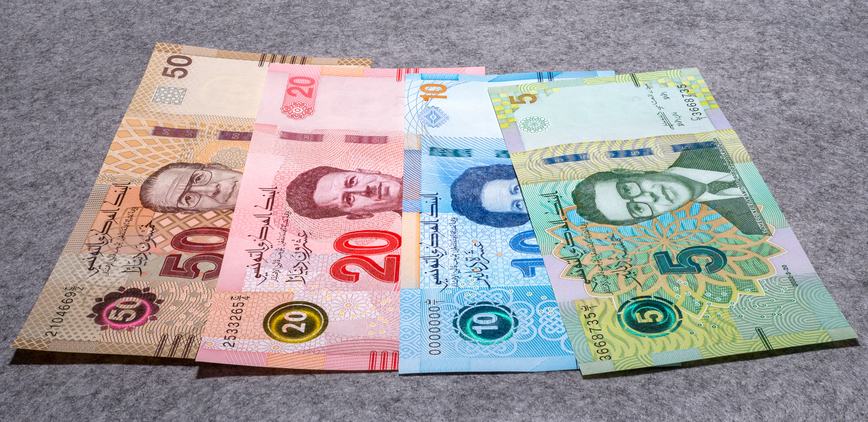
In April, the Central Bank of Tunisia (CBT) completed the introduction of its latest series of four banknotes, the 11th since its inception in 1958, making it one of Africa’s most prolific banknote issuers. Printed by Crane Currency, the four new notes in the series represent a break with the past, with a more modern design, new historical personalities and enhanced security features.

Tunisia is the northernmost country in Africa, bordered by Algeria, Libya and the Mediterranean Sea. It has a landmass of 163,600 km² and a population of 11 million.

It secured its independence from France in 1956, and took centre position on the world stage in 2011 with the Jasmine Revolution. Not only did this oust the president of 24 years, Zine El Abidine Ben Ali, but triggered a broader revolution across the region in the so-called Arab Spring.

Whilst the revolutions in other countries in North Africa and the Middle East either fizzled out or resulted in civil war and/or further repression, the transition to multi-party democracy in Tunisia was relatively swift and peaceful. It is the only North African country classified as ‘free’ by Freedom House and is one of the highest-ranking countries in Africa in the Human Development Index. It also has one of the highest per capita incomes on the continent.

The currency is the Tunisian dinar (TND), introduced in 1958 to replace the French franc. There are four banknote denominations– the 5, 10, 20 and 50 dinars; the share of each of the total volume in 2020 was 1%, 42%, 52% and 5% respectively. The 10 and 20 dinars notes are the two ATM notes.

The currency is sub-divided into 1,000 millims. Coins in everyday use are 50, 100 and 200 millims, and ½, 1, 2 and 5 dinars. 5, 10 and 20 millims are also legal tender, but rarely used.

As of the end of 2020 (the latest year for which central bank figures are available), the value of cash in circulation was TND 15.75 billion (up 16.6% from TND 13.5 billion in 2019). 97% of the value is in banknotes, and 3% in coins. The previous year’s growth was 8.5%.

The overall volume of banknotes grew by 24% to just over 900 million. The ratio of total cash in circulation to GDP amounted to 14.2% in 2020, compared with 11. 8% in 2019.

11 series, 36 banknotes

As noted earlier, CBT has issued 11 different banknote series from 1958 to the present day, distributed over three major periods.

The first period – 1958-1986 – covers the regime of President Habib Bourguiba, with seven series issued in 1958, 1965, 1969/1972, 1973, 1980, 1983 and 1986. On average each series comprised three denominations, except in 1986 when only one denomination, 10 dinars, was put into circulation. All the denominations (½, 1, 5, 10 and 20 dinars) used to show the portrait of the President on the front.

The second period begins in 1987 after the takeover by President Ben Ali. Two series were issued during that period, between 1992 and 2008. The first series comprised four denominations – the 20 dinars, which went into circulation in 1992, followed by the 5 dinars in 1993, the 10 dinars in 1994 and finally, the somewhat peculiar denomination of 30 dinars in 1997.

The second series was composed of two new notes – a 10 dinar issued in 2005, and a new high denomination 50 dinars in 2008.

The third period – 2011-2014 – started shortly after the Jasmine Revolution. The new series kept the themes chosen in the previous period but enhanced both the aesthetic design and the security features. The two high denominations, 50 and 20 dinars, were put into circulation in 2011, while the low denominations, 10 and 5 dinars, were issued in 2013.

The roll-out of the latest series began in 2017 with the TND 20. It features Farhat Hached (1914-1952), a trade unionist and pro-independence national who was also one of the key leaders of the pro-independence Tunisian national movement. His assassination in 1952 provoked protests throughout the Middle East. The reverse depicts the Roman amphitheatre at El Jem.

The second note to be issued was the TND 10 in 2020, during the early days of the pandemic. Fittingly, it features Dr Tawhida Ben Cheikh (1909-2010), Tunisia’s first female medical doctor. She practiced as a physician, paediatrician as well as a gynaecologist and was the founder of Tunisia’s first family planning clinic. The back features vignettes of pottery and Berber jewellery, along with floral and arabesque patterns.

In April this year, the final two notes were issued.

The TND 5 features Slaheddine el-Amami (1936-1986), a Tunisian agricultural engineer, noted for his contributions to the field of hydraulics and agricultural research. An image of the 82-mile-long Roman aqueducts of Zaghouan, one of the longest in the Roman Empire, appears on the reverse.

And, finally, the TND 50 features Hedi Nouira (1911-1993), one of the great figures of the Tunisian national movement for independence. He was the founder and first governor of the Central Bank of Tunisia at its creation in 1958 and until 1970, when he became Prime Minister until 1980. On the reverse is an image of the CBT’s modernistic headquarters.

The new banknotes were designed and produced by Crane Currency. All four denominations feature a 4.5mm wide RAPID® thread – in the case of the two most recent notes, the more advanced RAPID HD (high definition) version was deployed.

The notes also incorporate watermarks corresponding to the intaglio portraits with an electrotype of the denomination and SPARK® Live, used to represent the denomination numeral within revolving circles. The colourshift of the SPARK feature mirrors the colours of the banknote itself and the RAPID thread on each.

Subscriber content

Read the full article

Full access to Currency News articles, newsletters and archives.

Sign Up to Currency News Weekly

Receive regular updates on the latest news and articles posted on our website.