
Pinball Wizard
Whilst Crane Currency is, or rather was, first and foremost a paper maker, it is also the developer of the micro-optics feature MOTION® and its derivatives for threads and, more recently, for surface-applied stripes.
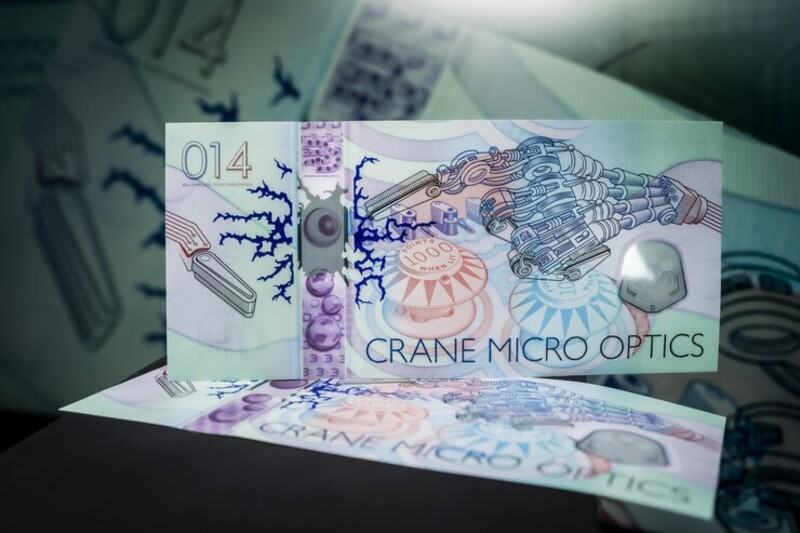
These to date have been utilised in paper currency only, but at the Global Currency Forum in early May, the company introduced a new polymer house note – the Pinball Note – with a variant of MOTION for the substrate, namely a 10mm wide MOTION SURFACE® stripe overlaid over a window.
MOTION SURFACE stripes of this width typically have an array of over 3 million lenses, aligned horizontally over 3 million icons. For the Pinball note, this has enabled four different effects to be created that continue the theme of the note itself.
They include the company’s ‘Sliding Bands’ effect (whereby, as the name implies, the bands slide around the 3D logo), animation (with the numeral 3 morphing into a D), Topo (with its strong 3D effect displaying as an arrow symbol), and Pulsing Shimmer to convey the shiny chrome surface of a pinball machine. The micro-optics element that appears over the window, a ball, appears to jump from the note itself.
A separate window, meanwhile, contains an image of a pinball machine which can be seen on either side of the note.
The Pinball note was a collaboration with CCL Secure, designed by Crane’s Edwin Thungren – specialist in digital communications with a background in retail graphic design – and printed at its facility in Malta. The choice of the theme of the note, and stripe, was intended to demonstrate movement, tilt and action – all aspects of playing pinball, and all central to the effects of MOTION.
Subscriber content
Read the full article
Full access to Currency News articles, newsletters and archives.