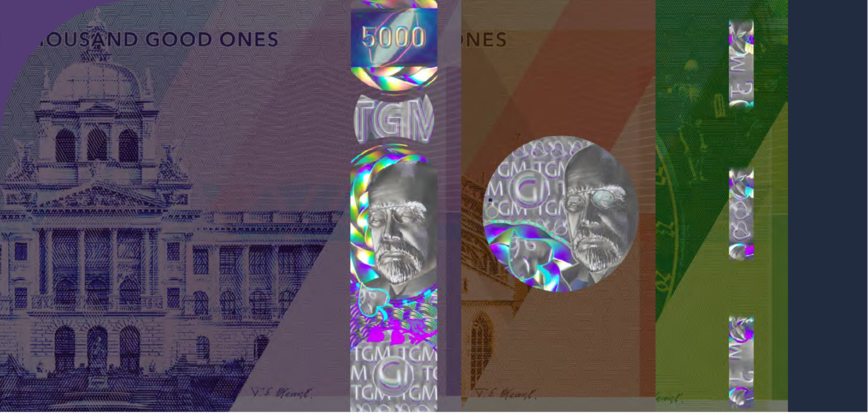
Interactive Features from IQ Structures
Following the return of in-person events, one company that has been prominent with its range of eye-catching optically variable features is IQ Structures, the largest of three subsidiaries of the IQS Group in the Czech Republic, which specialises in lithography techniques, 3D nano-printing and industrial replication of nanostructured materials.
IQS Nanoptiqs focuses on micro- and nano-structured optics for applications in LED lighting, sensors, and automotive lighting. IQS Nano develops lithographic and 3D nano printing technologies for use in 3D hierarchical architecture metamaterials and medical applications, as well as for anti-counterfeiting and micro/nanostructured optics.
IQ Structures, meanwhile, develops and produces security features for banknotes and high security documents which combine nano-scale precision with advanced aesthetics to create optical elements that are technically complex but easy to view and authenticate.
Sophisticated algorithms are used for creating the 3D surfaces and the company’s technologies allow it to record and build structures with a precision of several nanometres. The mastering technologies include electron beam lithography, UV lithography, laser interferometry, ion etching and 3D nano printing.
The optical features can be implemented in any foil construction and are suitable for paper, polymer and hybrid banknotes as stripes, patches or threads. The graphic themes and elements in the banknote’s design can be used to create coordinated visually attractive, diffractive patterns as well as strong overt colourless (achromatic) features that on their own, or combined with its diffractive features, allow easy and unambiguous visual authentication.
Covert as well as forensic elements can also be incorporated.
Of those achromatic features, IQ Structures now offers four distinct products that it describes as colourless and interactive.
White ID
First is White ID – the effect of which is a non-chromatic, bas-relief with high resolution details. It does not change its appearance when tilted or rotated and appears to have a depth of approximately 1mm. It is easily authenticated by its unique visual and 3D appearance – even though it is flat to the human touch.
Using the 3D scanning approach or modelling, any person or object can be reproduced.
Magnifysense
Second is Magnifysense, the effects of which consist of non-chromatic elements (letters, numbers, or geometrical designs) hovering below the plane of the feature. When tilting the banknote, the non-chromatic elements are magnified in the feature; the magnification can vary depending on the complexity of the elements.

Tilt and Move
Third is Tilt and Move. This effect is similar, but different, from Magnifysense. The effect again consists of symbols, letters, numbers, or geometric objects hovering below the plane of the feature. But when tilted, the elements move in a counter intuitive manner – eg. when tilted up and down the elements move left to right and vice versa.

Also, the moves of elements can be realised in different depths below the plane of the feature and a morphing or shape changing effect can also be integrated.
Keyhole
Fourth is Keyhole, an effect created by a non-chromatic element – symbol, letter, number, geometric object – that is hidden in or below a display area within the feature. The element is larger than the display area and so only part of the image is visible. To reveal the whole image the feature must be tilted left/right and up/down. The effect is particularly suitable for wide window threads and stripes.

All these features display the critically important aspects of highly effective level 1 banknote security features. They immediately attract the attention of the person using or examining the banknote, and then involve that person in carrying out simple hand movements to uniquely validate the feature.
The visual effects of these features can be viewed at www.iqstructures.com/en/banknotes.
Subscriber content
Read the full article
Full access to Currency News articles, newsletters and archives.