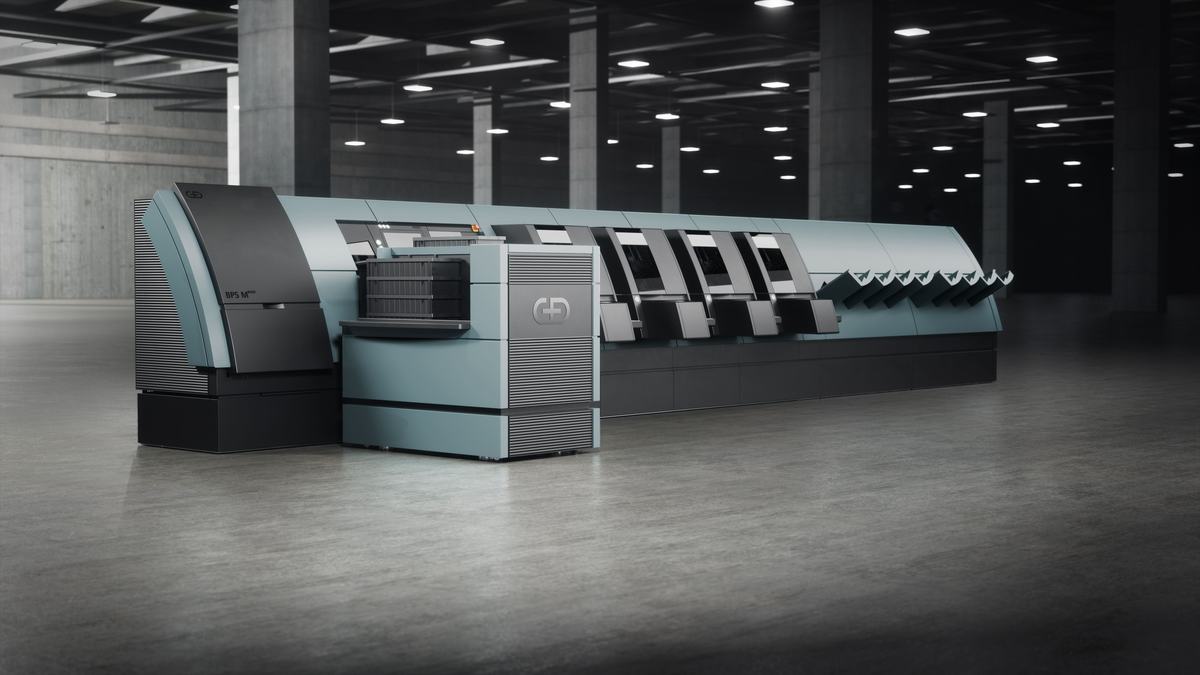
Next Generation Cash Processing from G+D
Giesecke+Devrient (G+D) has announced the next generation of its BPS® M systems for banknote processing. The BPS® M evo series systems, which are available in the M3, M5, and M7 models, feature new software, improved sensor evaluation, a new stacker module, and a modern visual design.
The BPS M series is specially designed for use in central banks and cash centres with a throughput of several hundred thousand to several million banknotes per day. They perform all work steps automatically, from banknote checking and sorting to packaging.
According to G+D, the central innovation of the new BPS M evo series is its powerful software, which includes an easy-to-use interface and a new software architecture. Significantly optimised guidance takes the strain off users, leads to fewer operating errors, and thus increases productivity in banknote processing. IT security has also been improved, with an integrated firewall and encrypted data transmission between the processing system and customer servers.
Customers can also benefit from software innovation via SensorFusion®, a process that uses intelligent sensor algorithms to optimise banknote classification (the process of determining whether a banknote is still of good circulation quality, unfit or even a suspected counterfeit).
The computing power required for this is provided by the SensorBrain® high-performance computer system, which is scalable accordingly. By merging different measurement technologies such as ultrasound, magnetism, and optical methods in the visible UV and infrared range, SensorFusion offers a completely novel approach to banknote classification, says G+D. This reduces manual post-processing work in the cash centre and minimises incorrect sorting of banknotes.
UV detection also has a 30 times higher resolution than before, as well as differentiation of the UV colours used. This means that the UV security features of banknotes can be fully exploited for improved authentication and sorting according to fitness for circulation.
Efficiency and sustainability
The new NotaTray Filling stacker module can be used as an option in the BPS M evo series. The module stacks the checked, counted, and sorted banknotes loosely in reusable banknote containers known as NotaTrays, instead of banding them with paper, bundling them in packs of 10, and then shrink-wrapping them in plastic film as was previously the case. This shortens the previous process and thus saves time and money, as the banknotes are packed and unpacked much faster and with less effort within the value chain.
G+D states that sustainability and efficiency for commercial cash centres increase significantly when using NotaTrays to fill ATM cassettes. They also eliminate the need for packaging material for banknotes, which can now be transported loose in the sealed trays - for example, from a commercial cash centre to the central bank. Sample calculations have shown that up to 175 km of banding material can be saved per machine per year.
The NotaTray Filling module not only optimises transport processes in the cash cycle, but it also saves labour efforts.
For example, the system can pick up rejected banknotes. Typically, unrecognised banknotes such as double prints or bills suspected of being counterfeit are collected in a dedicated stacker. Once it is full, an operator removes them. With BPS M evo, the NotaTray filling modules can collect up to 10 times more rejected banknotes. This further automates the process steps, manual intervention becomes less necessary, and the rejected banknotes can be processed efficiently.
In addition to new systems, central banks, commercial banks, cash-in-transit companies and casinos with existing BPS M systems can retrofit the new functionalities by an upgrade.
Subscriber content
Read the full article
Full access to Currency News articles, newsletters and archives.