
· 4 min read

National Day of Currency in Kazakhstan

Astrid Mitchell
Astrid Mitchell · Editor
National Day of Currency in Kazakhstan

In November 1993, the first President of Kazakhstan, Nursultan Nazarbayev, signed a decree ‘On the introduction of the national currency of the Republic of Kazakhstan’. Following this, the tenge became the official currency of the country.

The introduction of the tenge symbolised the move towards financial independence and sovereignty as the country transitioned from the Soviet ruble to its own currency.

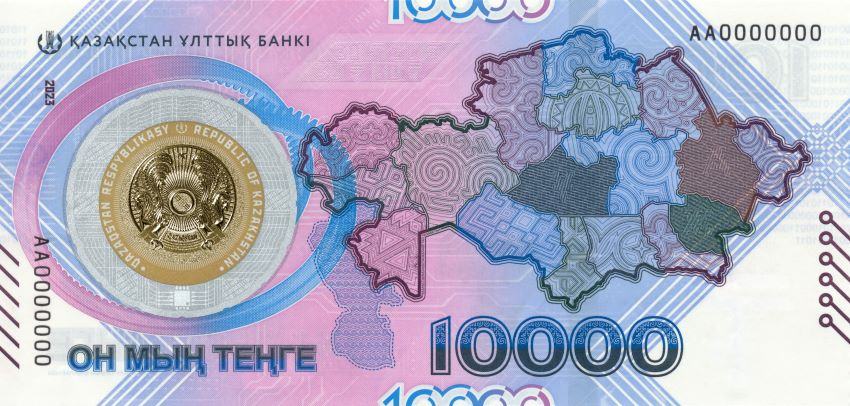
This special occasion is being marked by the issue of a commemorative 10,000 tenge banknote, featuring significant historical references and eye-catching design and advanced security features.

By way of background, the introduction of Kazakhstan’s national currency stemmed from economic challenges in the former Soviet republics, exacerbated by the Central Bank of Russia’s 1993 monetary reform that removed Soviet rubles from circulation and exchanged them for new Russian currency. The influx of Soviet rubles into Kazakhstan triggered hyperinflation, prompting the need for a national currency.

The name ‘tenge’ was chosen, inspired by medieval Turkic silver coins (‘denge’ or ‘tanga’). Subsequently, the opening of the National Bank of Kazakhstan (NBK) banknote factory in 1995 signalled Kazakhstan’s growing economic autonomy. The currency’s high quality, original design, high standard of workmanship and robust security against counterfeiting have earned it recognition and admiration internationally, not to mention a host of awards and other accolades.

Kazakhstan has also become a byword in the industry for its commemorative notes, which have pioneered new concepts in banknote design, materialised new ideas and served as a test bed and launch pad for many new technologies and features. Since 2008 ten have been issued.

The latest 10,000 tenge, the 11th, is no exception.

To mark the occasion in 2023

The 10,000 tenge was launched on 15 November, and in keeping with the Kazak tradition of innovation, hosts notable design and security features, 19 in total.

The predominant colour is blue-violet. The currency itself is the dominant design theme on both the front and back of the note, with the tenge symbol depicted in the context of digital time and intended to personify the dynamics of the modern, rapidly changing world.

The main motif is a commemorative coin, which features the national coat-of- arms, created in the note as a varifeye® ColorChange patch. In direct light, it resembles a glittering gold coin. When viewed through to a light source, the translucent symbol for the tenge currency is shown in blue. This effect is visible from both sides of the banknote.

This design can also be seen in the watermark, as well as when tilting the PEAK® together with the anniversary number 30. The front also includes a feature for the visually impaired in the shape of tactile convex high relief elements down either side of the note.

The front also depicts a map of Kazakhstan with regions decorated with various types of traditional Kazakh ornaments, which includes three highlighted new areas (latent images).

The reverse of the banknote depicts the general outline of a map of the Eurasian continent, symbolising the significance of the established state borders of Kazakhstan. The main security feature here is the 5mm Galaxy® security thread containing the tenge sign and the anniversary number ‘30’ in the thread. The colourshift is magenta-to-green, matching the SPARK Flow® PRIME, which again represents the tenge symbol.

3 million on the new notes have been produced.

New series to follow

As well as introducing the commemorative note, the NBK has unveiled details of a new series.

The current, fourth, banknote series (the Samruk Series), was introduced in 2011. It will be replaced by the fifth series, entitled the Saka Systel, starting with the 5,000 tenge by the end of the year.

The new series will convey the unique perspective of distant Kazakh ancestors, their connection with nature and the animal world in the country’s vast territory. Each of the animals chosen for each note is linked with the region that is the basis of that note’s theme.

The size of all notes is being reduced in keeping with global practise. The design of the front of each is vertically-orientated, and horizontally-orientated on the reverse.

The predominant image on the new 5,000 tenge is a golden eagle. It will go into circulation in December. The remaining notes will be issued at regular intervals – the 10,000, 2,000 and 1,000 tenges in 2024 in that order, concluding with the 20,000 and 500 tenge in 2025.

Subscriber content

Read the full article

Full access to Currency News articles, newsletters and archives.

Sign Up to Currency News Weekly

Receive regular updates on the latest news and articles posted on our website.