
· 6 min read

New Series for Barbados – Bajan to the Bone

Astrid Mitchell
Astrid Mitchell · Editor
New Series for Barbados – Bajan to the Bone

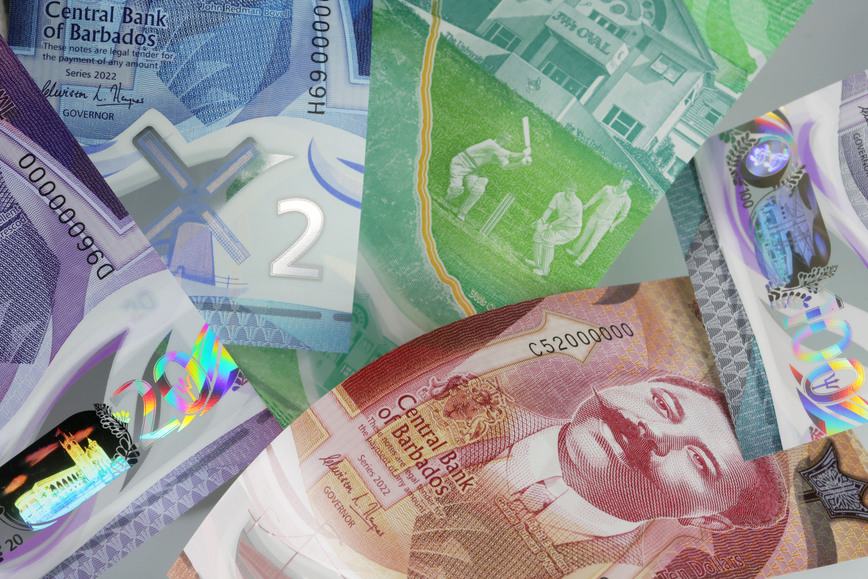
At the end of last year, the Central Bank of Barbados issued a new banknote series, coinciding with the 50th anniversary of its foundation, which is only the second major redesign in its half-century history of issuing the national currency (the 2013 series being the first). The whole series was converted to polymer, designed and manufactured by De La Rue on SAFEGUARD®, underpinned by a design philosophy that ensures they are ‘Bajan to the bone’, and supported by a public outreach campaign that sets a new bar for how central banks communicate with the public.

Barbados is the most easterly of the Caribbean Islands, and has a population of around 287,000 and a landmass of 432 km2, making it one of the world’s most densely populated isles. A former British colony, it became an independent state with the late Queen Elizabeth II as its head of state in 1966. In 2021, it transitioned to a republic within the Commonwealth with an elected president.

The Barbados dollar was introduced in 1973, replacing the East Caribbean dollar, and it is subdivided into 100 cents. The banknotes are denominated in 2, 5, 10, 20, 50 and 100 Barbados dollars.

With the existing series having been in circulation for nine years, the Bank made the decision in 2019 to review and upgrade the notes, and opted to switch to polymer after researching the different substrate options. Much of that research was done by an officer from the Currency and Payments Oversight Department, who made it the focus of her Master’s thesis.

Among the chief reasons for the eventual decision to go with polymer was the increased durability and enhanced security it offered. The Bank viewed the former as a cost-saving measure in the medium-term, and the latter as a way to maintain the already low incidence of counterfeiting in Barbados.

An additional benefit was the Bank’s ability to incorporate tactile features for the visually impaired that could last the lifetime of the note (a similar attempt was made in 2013, but the marks became less pronounced as the notes got older). These features comprise raised dots making up different geometric chapes according to the denomination.

In terms of the design, the Bank opted to retain the colours and portraiture (national heroes on the front, famous locations and landmarks on the reverse relating to those heroes) for continuity, but changed the orientation to vertical, which allowed it to showcase these elements in a fresh way. Also incorporated on the notes were additional national symbols, including lines from the national anthem, and a partial outline of the map of Barbados on each note, which becomes the complete outline when the full series is viewed together in two rows of three.

Security features, meanwhile, include the reflective ARGENTUM™ in the window on the three lower denominations, and a holographic stripe incorporating De La Rue’s SPOTLIGHT™ feature (which depicts counter rotating holographic images) in the window on the three highest denominations, visible on both sides of the notes.

The front of the banknotes utilises the Enhanced GEMINI™ UV feature to depict important national symbols of Barbados, including the national symbol of a broken trident. The satellite map image, which appears in segments on each of the reverse of the notes, also glows under UV light.

Public education

Rather than what might be considered a traditional public education effort, the CBB approached preparing the public for the new series as a marketing campaign, the basis of which was designed when a member of the Corporate Communications team used the upcoming new series as the subject of her capstone project for her Master’s degree.

Adopting a marketing mindset ensured that the Bank didn’t only inform the public about the new series, but also built excitement and anticipation for it. The aim was to make people pay attention to the information the Bank was putting out and, critically, to share it, thereby increasing the number of people who were aware of the upcoming change.

The messaging for the campaign was focused on how the new series would benefit Barbadians. As an example, while polymer’s durability was a major factor in the decision to change substrates, that is largely a benefit to the Bank and not something that would directly impact the average Barbadian. As a result, while this was mentioned, the emphasis was on how much harder the notes are to counterfeit, something that people who use cash are more concerned about. The increased accessibility of the notes was also highlighted, as this is something people would view favourably.

The Bank spread and reiterated these messages using a variety of media, including video, web articles, graphics, segments on the radio, and television appearances. In each instance, it strove to make the content appealing by using a friendly rather than authoritative tone: the articles were blog-style, the radio segments were conversations rather than interviews, and the videos were engaging.

The Bank adopted the same approach for in-person events. For the launch event, it avoided speeches as much as possible and instead had a discussion that also incorporated audience questions. And while there was a live audience, the set and overall direction was planned with video in mind since this is the medium through which most people would view it.

The Bank marked the notes going into circulation by joining with a leading radio station to do a mini roadshow (dubbed the Polymer Road Runner event), enabling it to showcase the notes to members of the public and get their feedback.

The campaign also included the usual public education materials: flyers, booklets, posters, and security feature videos. However, these were made available later in the campaign to coincide with the notes going into circulation. The lead-up focused on building awareness and positive perception.

A survey conducted in September (three months before the notes went into circulation) confirmed the success of this approach: 75% of respondents were aware of the new series; 54% were aware of the reason for the change; and 69% had seen the designs. Of those that had seen the designs, 47% liked them, 27% thought they were ‘OK’, and 23% said they were only concerned with the designs ‘as long as I can spend the notes’. Only 2% said they didn’t like them. 88% indicated that all the questions they had about the new series had been answered. The Bank asked those that had questions to share them, and used those as the basis for FAQ videos, articles, and social media posts.

Reaction to the new series

Reaction to the new series has been positive, according to the Bank, with people expressing excitement about the notes in the lead-up to their issue.

‘I think they’re absolutely gorgeous, and I think they’re a fantastic representation of Barbados and Barbadiana in all its forms. It’s really nice,’ said one launch attendee. ‘Really love how the new layout is, with the vertical look and feel. Very, very modern,’ said another.

A comment on YouTube, meanwhile, said it all – ‘OMG… I had a mini freak out. It looks so artsy clean and well-designed. Good job.’

Representatives from the visually impaired community were also very appreciative of the Bank’s efforts to make the notes more accessible, and invited the Bank onto their radio programmes to speak about them.

The new notes are being put into circulation via commercial banks through ATMs and over the counter, and will co-circulate with the old paper notes, which will gradually be withdrawn from circulation.

More details of the new series can be found at https://youtu.be/jhLDcFLLb6c.

Subscriber content

Read the full article

Full access to Currency News articles, newsletters and archives.

Sign Up to Currency News Weekly

Receive regular updates on the latest news and articles posted on our website.