
Gifting Money – My Personal Experience
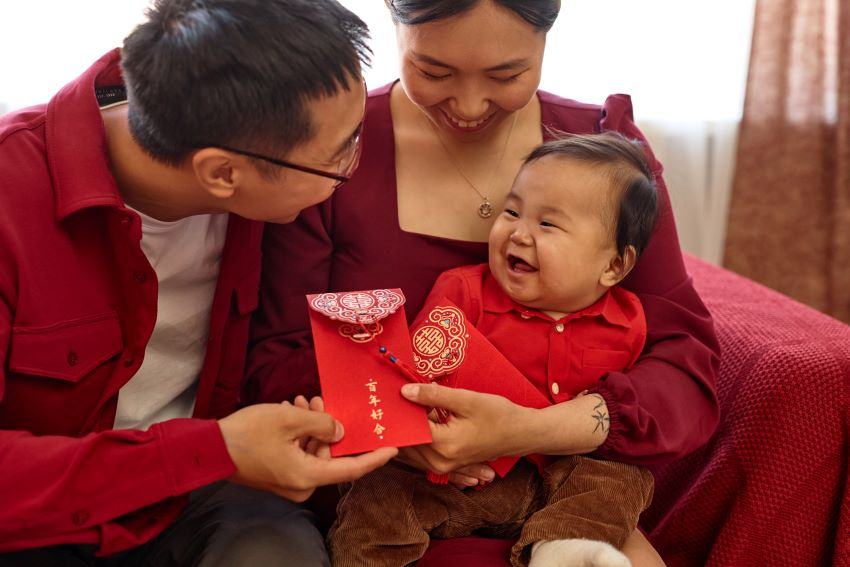
This is the first in a series of articles that explores the cultural aspect of money that goes beyond its function as a means of payment or store of value. Many societies have a long-standing tradition of gifting money (banknotes and coins) to mark auspicious occasions – births and birthdays, weddings and other special events, where the value of the gift is as much social as it is financial.
We start the New Year, appropriately, with a personal view of the tradition of gifting money to celebrate Chinese New Year, and its origins.
Chinese New Year is the festival that celebrates the beginning of a new year on the traditional Chinese lunisolar calendar. This year, it will fall on Saturday, 10 February, and the Year of the Wood Dragon will start. The Dragon symbolises power, nobility, luck and success in traditional Chinese culture and will bring growth to everyone.
The Chinese New Year is traditionally a time to feast and visit family members.
When I recall the Chinese New Year celebrations of my childhood in Shanghai in the early 1980s, vivid memories come flooding back. The joy on people’s faces, the aromas and sounds from the kitchen. The stylish new clothes I proudly wore, the tons of cakes and fruits brought by visitors.
But the most exciting moment for me was to wake up on the New Year’s morning and look under my pillow, where my grandparents had placed red envelopes containing brand new banknotes on New Year’s Eve.
In the following days of the Chinese New Year, I received more red envelopes from other family members. This ensured my annual ‘income’ for sweets and treats. It was always a challenge to negotiate with my parents how much of the money I was allowed to keep and how much I had to hand over to them.
Now, I have my own income and am married, so I no longer receive red envelopes for Chinese New Year. However, thanks to new technology, we have introduced the tradition of digitally ‘fighting’ for money. In my father’s family, we have a large WeChat family group with over 20 members. Some family members create digital red envelopes with symbolic value in the group chat, and everyone tries to grab them in the first second and transfer the amount into their digital wallet.
It’s really fun and creates a very unique and strong sense of togetherness, particularly as my family is spread across several countries around the world. Although we don’t see each other physically, we feel connected at that moment.
Of course, despite the widespread use of digital payments, it is still very important to hand over the physical red envelopes for those who can meet in person.
The legend of Yasui Qian
The money which elderly people would give to those who are still in education during the Chinese New Year is often called Yasui Qian, meaning money which suppresses ghost.
According to a legend, there was a small demon with black body and white hands, named ‘Sneaky’, which appeared every year on the 30th night of the New Year to harm people. It would touch the head of a sleeping child three times, after which the child would fall ill and turn into a demented fool.
People were afraid their children would be harmed by the evil spirit, so they lit lamps and stayed awake during the night.
There was a family named Guan living in Jiaxing province. On the night of the 30th day of the year, Mr and Mrs Guan, afraid that the demon would harm their child, let him stay awake and play. The child used red paper to wrap eight coins and then unwrapped the package again. When bedtime came, he put the eight wrapped coins beneath his pillow. The couple did not dare to close their eyes and stayed awake next to him. In the middle of the night, a gust of wind blew open the door of the room and blew out the lamp, the little man with his white hand touched the child’s head, at which point the pillow emitted a bright light, the demon hastily retracted his hand screaming and fled.
The Guan family told everyone about the story of the eight coins wrapped in red paper to scare off the spirit. From then on, everyone learnt to wrap eight coins in red paper and give them to their children to put on their pillows after the New Year’s Eve dinner, and sure enough, the children were never harmed again. It turned out that the eight coins were changed by the eight immortals, who secretly helped the children to scare away the evil spirits.
Therefore, people call this money ‘压祟 钱 – Ya Sui Qian’, money which suppresses ghost. Since the word ‘祟 Sui’ and the word ‘岁Age’ have the same pronunciation, it became known as ‘New Year’s Money’.
Over time, parents began to give their children new banknotes with interconnected serial numbers to mark New Year. This is because the term ‘联 (lián) sounds similar to ‘连’ (lián), implying auspicious wishes for the children to ‘连连 发财’ (lián lián fā cái), meaning continuous prosperity, and ‘连连高升’ (lián lián gāo shēng), suggesting continuous success and advancement.
Part of the culture of giving is the use of the red envelopes to enclose the money (a custom widespread in Asia) – which themselves are often a work of art.
According to a survey published by a Chinese Wealth management company, the amount of each envelope varies from 50 RMB to 3,500 RMB (c. $7-$490). The amount is usually an even and thereby lucky number.
Subscriber content
Read the full article
Full access to Currency News articles, newsletters and archives.