

In Other News
Hungary’s central bank – Magyar Nemzeti Bank – has released a series of six new commemorative coins to celebrate the 75th anniversary of the introduction of the forint.
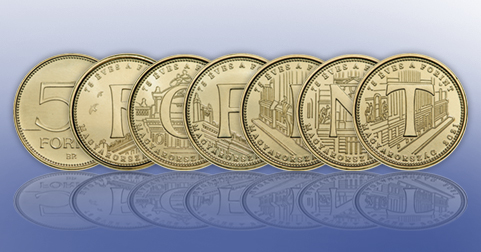
The new coins, all different versions of the 5 forint, have been produced by the Hungarian Mint at its facilities in Budapest. Each of the six designs includes a portion of the side or corner edifice of the National Bank along with the letter F, O, R, I, N or T. When placed together in a specific arrangement, a greater image of the Bank building can be seen, as well as the full name of the currency.
The designs are being released weekly one at a time, beginning with the coins featuring the letter F. Each coin has a mintage of two million pieces; at 12 million pieces in total, they represent the largest mintage of commemorative coins ever released in Hungary.
The Central Bank of Sierra Leone has announced the removal of three zeroes from its currency and the introduction of a New Leone series of notes and coins. The notes will be denominated in 1, 2, 5, 10 and 20 New Leones, and the coins in 1, 5, 10, 25 and 50 cents.
The new currency will become legal tender ‘in the near future’, according to the Bank. It will co-circulate with the current currency (the Old Leone) for a short period, after which the latter will cease to be legal tender.
The Central Bank of Venezuela has confirmed the creation of a digital bolivar and the redenomination of the currency – the third since 2008 – by eliminating six zeroes, to take effect 1 October. The new series will be denominated in 5, 10, 20, 50 and 100 bolivar soberanos. There will also be a new 1 bolivar coin.
The Central Bank of Egypt has published a preview of the designs of its new 10 and 20 pound polymer notes, due for issue in November. They are being produced at the Bank’s new printworks in the New Administrative Capital.

The South Pacific nation of the Cook Islands issued a new $3 banknote on 3 August as part of its Constitution week celebrations. This replaces the previous design which was first issued in 1987. The $3 is the only note issued by the MFEM (Ministry of Finance and Economic Management), which co-circulates with the New Zealand Dollar.

The note is printed on De La Rue’s SAFEGUARD® polymer substrate. Security features include a see-through polymer window, micro text and the Enhanced GEMINI® UV element.
Following the issue of the Bank of Scotland’s new £50 polymer note last month, the Royal Bank of Scotland (RBS) has now followed suit with its version. It portrays women’s education pioneer Flora Stevenson and the Scottish Osprey and is the fourth note in the RBS’s Fabric of Nature series, which began in 2016.
The note, in common with those issue by the Bank of England and the Bank of Scotland, is predominantly red in colour, printed on SAFEGUARD polymer, and features a large window with a holographic stripe.
Subscriber content
Read the full article
Full access to Currency News articles, newsletters and archives.