Aeris™ Proven to Eliminate COVID 19 in One Hour
Spectra Systems Corporation launched its novel approach to cleaning soiled banknotes with the launch of its Aeris™ system in 2014 (See CN July 2014). With the arrival of the COVID-19 pandemic and the ensuing widespread publicity that banknotes were, or could be, one of the ways in which it was being spread, the industry looked for both solutions to providing clean banknotes as well as testing to prove that banknotes were not transmitting the virus.
Spectra Systems sought to prove that the Aeris machine, as well as cleaning banknotes, was also effective in deactivating the COVID-19 virus and any other viruses on banknotes at the same time. To do so it engaged the independent, world renowned National Emerging Infectious Diseases Laboratories (NEIDL) of Boston University to carry out work to validate its assumption.
Whilst those tests have been taking place, Spectra Systems developed a new machine in the fight against the COVID-19 virus and other pathogens (see CN Protecting Cash Against COVID supplement Pt 3, July 2020). Named the Spectra BDS-1000 system, it can disinfect around 5 million banknotes an hour to sterile levels and is ideally suited to smaller countries, commercial banks, casinos and other institutions wishing to disinfect and recycle banknotes.
However, it operates using a different method – heat disinfection in an oxygen free nitrogen environment - from Aeris and does not clean the banknotes at the same time. Since its introduction of the BDS-1000, Spectra Systems has developed smaller disinfection systems that process banknotes at the rate of 250,000 per hour.
Test to establish the survival rate of COVID-19
The experiments to determine the disinfection efficacy of the Aeris process were performed in the biosafety level 4 (BSL-4) laboratory directed by Dr Anthony Griffiths, Associate Professor, Microbiology at Boston University and NEIDL.
They involved the placement of polymer and paper-based banknotes in 100 note straps in a supercritical CO2 chamber operating at a temperature of 40ºC and a pressure of 100 bar for one hour.
A volume of 100 µl SARS-CoV-2 (2.78 x 10⁴ PFU/ml) (SARS-CoV-2/human/USA/WA1-2020 –) was pipetted onto the banknote in the strap for each of the three different currencies.
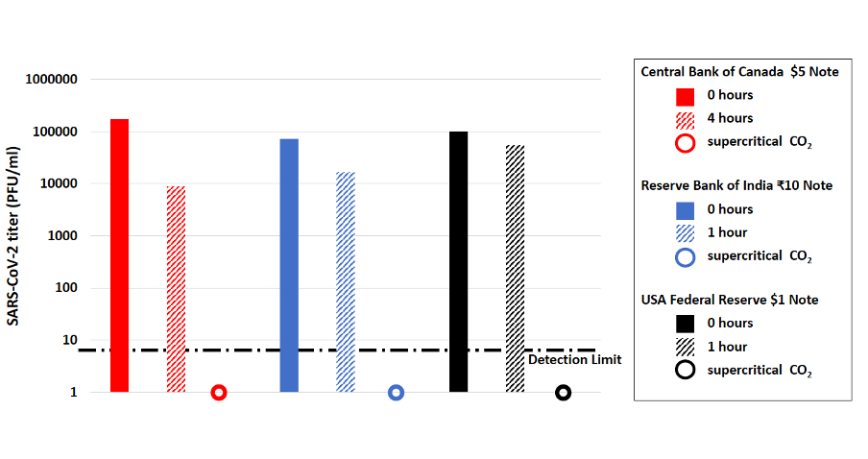
A plaque assay was performed to quantitatively determine the SARS-CoV-2 levels on the banknotes at the centre of the 100 note strap. The assays were performed prior to supercritical CO2 treatment, after one hour at 22ºC in air, and after one hour in the supercritical CO2 chamber. The notes kept outside the chamber provided a reference value to evaluate the efficacy of the Aeris process.
The results are shown above.
As can be seen, the virus is still prevalent on the banknotes after one hour in air in the case of the Indian 10 rupee and US$1 banknotes, and after four hours on the Canadian $5 banknote. But after going through the supercritical CO2 cleaning process in the Aeris machine none of the COVID virus survived.
In conclusion, the independent testing proved that the Aeris machine can both clean and disinfect (eliminate COVID-19 and any other viruses) banknotes at the same time in a cleaning cycle.
Subscriber content
Read the full article
Full access to Currency News articles, newsletters and archives.