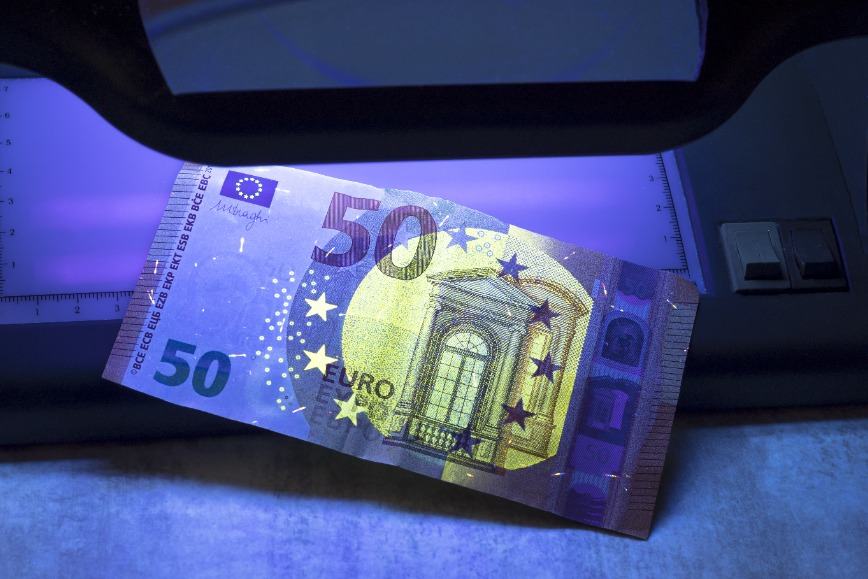
Banknote Security: Getting People to Pay Attention
The Bundesbank reported in August 2020 a marked increase in counterfeits where no attempt had been made to mimic the security features. There is a high level of trust in the authenticity of euro banknotes*.
The public also have a low level of knowledge about security features. For example, the Dutch National Bank (DNB) has found that although 75% of people surveyed know there is a watermark in the paper, only 5% knew what the watermark image was.
In this context, the DNB has carried out research to understand whether banknote designs can be used to highlight security features and improve counterfeit detection.
Frank van der Horst presented at the virtual International Banknote Designers Conference on his paper ‘Enhancing Banknote Authentication by Getting Attention to Security Features . The idea is that if the banknote design can get a feature to ‘pop out’ then the viewer is drawn to what has been highlighted.
But is there any proof that this works? Does the highlight, in this case an orange line drawn around an area of the banknote, work better if it is near the feature or far away?
How the research was organised
The experiment was carried out online with 422 participants. They were shown 24 randomly organised images for one second and asked if the note was genuine or not. The notes were shown to them in three batches and they were told that in the first batch one in three was fake, in the second two out of three were fake and in the last batch half were fake.
In fact, all three batches were the same with 50% fake. This batch approach was used to see whether higher trust leads to worse performance.
The notes were organised to model three scenarios. First, notes with no cue to focus the eye, with the cue on the left and on the right.
Second, notes were shown in batches to test trust. Finally, notes were either genuine or fake.
Goal of the research
The research explored three hypotheses:
1. If the highlight is located near to the security feature rather than being away from it, identification of the counterfeit is better.
2. If trust is low, people are better at detecting counterfeits.
3. If trust is low, then using an element highlighting the security feature will lead to better counterfeit detection.
Results
The results supported the first two hypotheses. It also showed that if there is high trust, people were less likely to identify a counterfeit. The highest score for identifying counterfeits correctly was 54%, a low figure. In order to understand whether the time limit was too short, the research was repeated with 66 students without a time limit.
The result was that all scores increased, and the original findings were sustained.
Lessons learned
The research shows the benefit of spending more time inspecting security features.
A difficult task, perhaps, to achieve but a message that needs to be built into public education and training.
It also showed that although high trust is the goal, it then works against people taking care to identify counterfeits. Central banks need to consider the balance between downplaying the risks and alerting people about counterfeiting.
Finally, the research is useful for banknote designers. It showed that putting a highlight near a security feature to draw attention to it worked better when it is close to it. Future research will involve designers to explore this further.
The full report can be downloaded at www.dnb.nl/media/qg0fdtl3/working_paper_ no-_716.pdf.
*Working paper 716, June 2021, co-authored with Joshua Snell and Jan Theeuwes from Vrije Universiteit, Amsterdam.
Subscriber content
Read the full article
Full access to Currency News articles, newsletters and archives.