
· 2 min read

Pakistan Proves Waste and Manure Combination as Answer to Banknote Destruction

Astrid Mitchell
Astrid Mitchell · Editor
Pakistan Proves Waste and Manure Combination as Answer to Banknote Destruction

As noted in the recently published special report ‘Cash: A Roadmap to Sustainability’, there is an environmental cost to the removal and disposal of banknote waste during production and at their end of life.

Polymer waste and banknotes are increasingly being recycled into industrial products. The same is happening to some banknotes too, although more traditionally they have either been incinerated or sent to landfill, which gets rid of the waste but also pollutes the environment. Composting, however, whereby a biochemical process transforms waste organic matter into ‘humus, is another option.

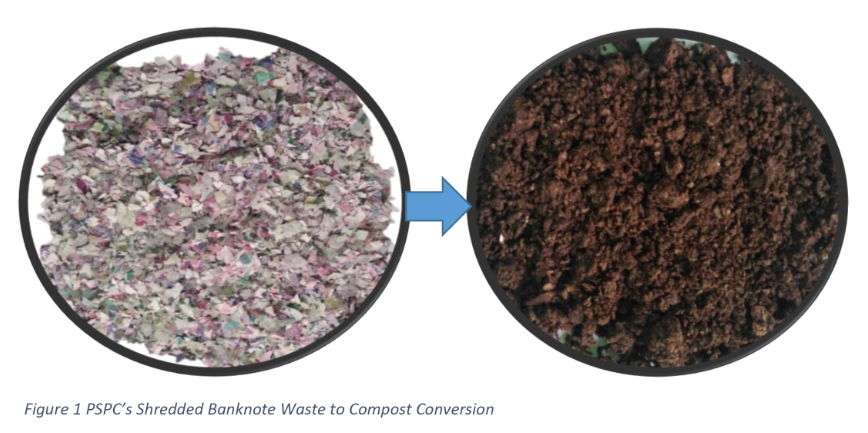
This is a route that some central banks and printworks have already taken. But, according to the Pakistan Security Printing Corporation (PSPC), no research has been done specifically on the identification of optimum parameters for banknote wastepaper composting and its environmental impact. PSPC is now undertaking that research, one project for which is a recently concluded composting experiment on waste shredded paper.

In order to evaluate the evaluate the physicochemical and final compost quality, briquettes of shredded paper bank notes were blended with other biodegradable waste material (specifically, cow manure) and composted using an open-air windrow system (a windrow is typically a row of cut hay or other agricultural material which piled is up and allowed to dry by wind before being baled, combined, or rolled).

The composting was conducted by placing waste banknote paper and the cow manure in specially designed windrows, which were then turned manually for mixing and aeration. For better aeration, the material was continuously turned and mixed to enhance the efficiency of aerobic bacteria.

Three sample sets were investigated, with banknote paper and cow manure mixed in proportions of 50:50, 60:40, and 70:30. Moisture, temperature, and pH data during the composting of shredded banknotes was monitored on a daily basis. The duration for turning raw material into mature and good quality compost was 50-60 days.

All three samples resulted into good quality compost. The 50:50 sample produced the best quality compost with all the nutrients required to replenish the soil. The research concluded that composting is a feasible option for utilising banknote paper waste, ie. free from high levels of heavy metals and rich in organic nutrients.

PSPC shreds an average of 1-1.5 tonnes/day of wastepaper. Based on the success of the experiment, it now plans to develop a large-scale windrow composting facility during the current financial year over an area of 3,000 m². The composting site will have a capacity to turn and mix around 2 tonnes of waste banknote paper and 2 tonnes of manure through seven windrows.

Subscriber content

Read the full article

Full access to Currency News articles, newsletters and archives.

Sign Up to Currency News Weekly

Receive regular updates on the latest news and articles posted on our website.