
· 5 min read

‘Cash: a Roadmap to Sustainability’

John Winchcombe
John Winchcombe · Editor
‘Cash: a Roadmap to Sustainability’

With the UN Climate Change conference, COP 26, taking place through early November, we thought it would be appropriate to review the environmental work of stakeholders in the cash industry over the last few years.

We wanted to consider the production and operational activities of coins and banknotes end-to-end from creation to destruction, and to consider cash in the context of wider payments. As importantly, we wanted to share widely what has been done so that others can learn and consider doing it themselves.

Payment context

We ran into some challenges. First, although there are a number of published Life Cycle Analyses (LCAs) carried out by central banks, most exclude coins. The most recent LCA published with coin data was the Dutch National Bank’s (DNB) which was from 2018 but using 2015 data.

Second, studies of the environment impact of payments are even rarer. We could not find a central bank study and, although the DNB’s paper did draw on a data from an academic paper about the impact of debit cards, again, this was dated. Trying to establish the environmental impact of card payments, let alone internet and mobile payments, was impossible.

In the end we went with the DNB’s 2018 staff working paper as our base data, accepting its age and a number of criticisms made about it, particularly the coin assessment.

Key findings: payment context

While the average cash payment may use 4.6g of CO2e (carbon dioxide equivalent), a bar of milk chocolate is 200g CO2e. Relative to the items being bought, payment is a low impact activity.

The DNB study was clear that the global warming potential (GWP) of cash payments in 2015 was extremely small, only 0.009% of the Dutch economy. Coin and banknote production was responsible for 12% and the operational cash cycle 88%, with transportation and the electricity used to run ATMs the main contributors.

The GWP of the cash payment system is less than the debit card payment system relative to the Dutch economy.

Since 2015 the number of Dutch ATMs has dropped 56% and the number of cash transactions has fallen from 3.7 billion in 2015 to 1.29 billion. The DNB is re-working its LCA and it will be interesting to see the new figures when it is ready.

While non-payments have a lower environmental impact than cash, they come at a cost and this is rising as the absolute number of digital transactions rise. Apportioning the environmental cost of cloud computing, data centres, communications and digital devices is difficult territory. Plastic cards, and all the processes to post out and manage those cards, is somewhat easier. Again, we await a definitive central bank study to address this area.

Case studies of environmental completed initiatives

24 organisations in the cash cycle provided us with 106 projects they have carried out over the last few years. We asked that they include only completed projects and evidence of what those projects had delivered. Our goal was to avoid what is known as ‘green washing’, marketing spin that claims good works when in fact there is little actual achievement.

We also asked for a range of projects from the micro (eg. changing to LED lights), up to major changes such as investing in solar farms. And we wanted an indication of what was involved in doing the project where appropriate. We want readers to be able to learn from the experience of the contributors.

Breadth and depth of work done

There is something for everybody here.

Many companies have invested in solar panels, some on roofs, some in solar farms, large scale and small. The Royal Australian Mint explain how this was financed through a long term contract so all the upfront costs were paid by the electricity company.

Tackling wastewater is a common theme across almost all production stories. Crane has installed a water treatment plant based on ultra-filtration that is a wastewater free process in Malta, which has no natural water resources. Oberthur Fiduciaire tested 34 different wastewater solutions before making a decision. It then worked with a local company to develop a new approach. Oberthur Fiduciaire now recycles 100% of the water produced.

On heat exchange, Koenig & Bauer Banknote Solutions uses thermo regulation to recover heat on their presses, De La Rue has installed high energy efficiency regenerative thermal oxidisers, Louisenthal uses heat exchanges to recover heat from their paper making operations to heat the plant.

As regards recycling, De La Rue and CCL Secure have worked hard on recycling polymer notes, but across the industry this has had much attention. Companies such as Komori are a long way down the path to zero waste.

Significant work has been carried out on reducing the use of plastics. One Loomis company slimmed down the number of types of plastic bag they used from 106 to 11. Another organisation trialled reducing the weight of plastic from 60 to 40 microns. Luminescence moved to laundering cleaning rags in place of single use rags. Glory now reuses material used to cushion components shipped between Glory sites.

Vaultex explains their ‘Green Path’ programme, where their staff have driven significant successes in reducing a wide range of impacts.

Much work has been done to reduce the impact of sites. The Royal Dutch Mint and Koenig & Bauer designed new sites as part of this, while Oberthur, Komori and others record the changes they have made.

Such a summary is an injustice to the wide ranging work done by all in this report.

Industry co-operation and focus

An important element of the achievement is how organisations have co-operated with others. Some have set out to find partners to develop new solutions and others have bought in expertise.

This report gives the example of the European Central Bank’s environmental actions, the International Association of Currency Affairs environmental awards, ATMIA’s work to drive recirculation through universal deposits and the Next Gen ATMs and the International Currency Association’s (ICA) Sustainability Charter. All of these give context and urgency to industry wide action.

We pay considerable attention to what we think is a unique initiative, the UK’s Cash Industry Environmental Charter (CIEC) group, and associates, who have an active programme of information sharing and co-ordinated action, including representation from the Bank of England, to make the cash cycle have lower impact.

The future

The report does include thoughts on options for reducing the impact of cash on the environment in the future. Not an exclusive list, of course, but a demonstration of the sort of changes countries and organisations can consider.

Webinar: 4 November

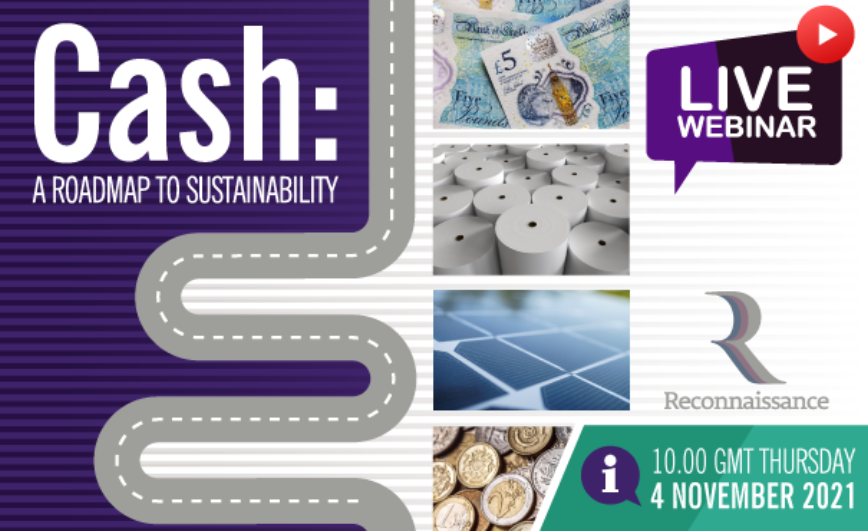
A webinar has been organised to coincide with the actual COP conference in Glasgow (1-12 November), to consider the white paper. Coin and banknote manufacturers are represented by Ross MacDiarmid of the Mint Directors Conference and Jutta Buyse of the ICA and the cash cycle by Leeann Shanks from NatWest, which drove the formation of the CIEC.

Subscriber content

Read the full article

Full access to Currency News articles, newsletters and archives.

Sign Up to Currency News Weekly

Receive regular updates on the latest news and articles posted on our website.