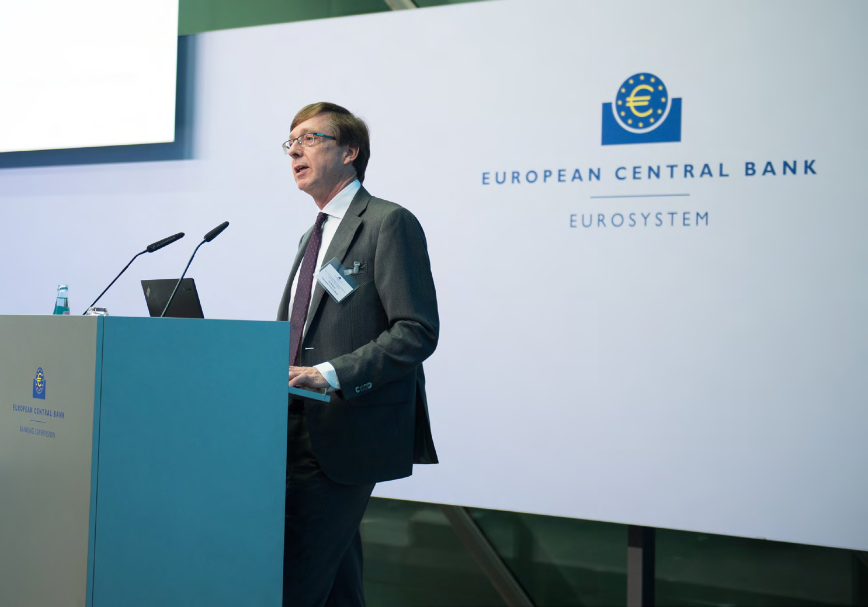
The Challenges and Achievements of a 23-Year Career in Banknotes
Ton Roos, who was appointed Director, Banknotes at the European Central Bank (ECB) in 2008, retired on 31 January.
He took on the position at the time of the financial crisis, and has had to contend with two subsequent crises. At the same time, he oversaw the introduction of the second (Europa) series (and is leaving just at the point that the third series gets underway), as well as ensuring the continuing supply of banknotes in an increasingly less- cash society whilst putting sustainability at the heart of banknote production and circulation.
Currency News™ spoke to him about the challenges and achievements of his career in the ECB, and what he will miss about the banknote community when he leaves, after 23 years in the community.
Q: Tell us a little about your background.
A: I am a chemist by training. I spent four years working in a university as a research chemist and then 15 years working for Akzo Nobel, a Dutch international chemical company, before joining the Dutch central bank in 1999. I joined the ECB in 2008.
So there you have my career in a nutshell!
Q: What has been your greatest challenge?
A: The big challenge was a production one. When I came to the ECB, we were facing the challenge of the new Review portrait window feature for the second euro series that now appears in the €20, 50, 100 and 200 banknotes. It was the first time this was being used in paper banknotes of any volume, and whilst everyone loved the feature, it was a real challenge to produce it on a large scale and consistently for the billions of notes that have to be produced every year.
It took us some years to develop the right process production equipment, and we had to have really good cooperation with the foil printers involved and printing works Europe-wide in order to get this done.
So that was a big challenge, and resulted in delays to the introduction of the second series. Of course, it is history now, but it was a real headache at the time.
Q: And your greatest achievement?
A: I’m not saying that this is my achievement, because it’s down to teamwork involving all the staff and national central banks (NCBs) of the Eurosystem along with the joint research teams, the law enforcement and the banknote communication teams, but what has been a great achievement is the counterfeiting rate. It isn’t only dropping because of the pandemic, which some people might say, but has dropped almost in a straight line since we issued the new €20 in 2015. The biggest impact has been in the €20 and €50, which are the most commonly used denominations.
We now have an all-time low counterfeit rate - in the range of 12ppm. I was already joking to my staff that it is a pity that I cannot stay two years longer because if I extrapolate the line then we might one day hit zero!
Q: Two big events during your time have been the financial crisis and COVID. Did you learn anything from the financial crisis that applied to COVID?
A: Actually for us it’s three, because there was also the government debt crisis in between in the eurozone
We learned a lot from the financial crash of 2008 because at that time there was a huge demand for high denomination banknotes. There was an outflow in a couple of weeks of about €40 billion. That’s a lot and so our stocks were heavily affected. At the time we learnt how important this is, so we have since then increased our stocks of high denomination notes in order to be ready to face any possible new crisis.
That came with the government debt crisis that followed the financial crash. Taking Greece as an example, they went for a big part to a cash economy because people no longer trusted the banking system. The amount of cash needed tripled, but thanks to the experience of the financial crisis, we had sufficient stocks to address this.
We saw the same effect in the pandemic, the only difference being that there were large outflows of lower, payment, denominations as well – ie. the €5, 10 and 20.
"We now have an all-time low counterfeit rate - in the range of 12ppm. "
Q: Were you able to keep the cash flowing and meet demand?
A: Of course – that’s our most important objective. We have to be able to always meet demand everywhere. During the first crisis we felt that we came a little closer than we would have liked to not being able to do that. By the time of the pandemic, however, we were definitely in a much more comfortable position.
The thing with crises is that you can’t predict them. And if one hits, we can’t produce banknotes overnight. That can take months. Hence, it’s always good to be prepared.
Q: With the increased demand for cash when the pandemic struck, is it beginning to come back now or is it still all out there?
A: It’s still out there. And euros in circulation keep going up, between 6-8%, every year.
Q: Regarding (mis)information around dirty cash, how quickly was the ECB able to respond?
A: We responded as quickly as we could. We couldn’t respond any faster because, as the ECB, when we say something then we have to be sure that it’s reliable. We had to base what we said on scientific studies, which we commissioned to several laboratories. That took some time, but it led to the conclusion that the risk of COVID transmission through banknotes is so extremely small that you shouldn’t be worried. You can more easily be affected if you touch a door handle or that kind of thing. In other words, cash is really safe.
Q: How did you manage the ECB’s function and the cash function in a time where people had to work from home?
A: Our IT people did a great job because they have really levelled up enormously our IT capacity, our internet functionality, and we all have learned very quickly how to deal with online tools that we didn’t use so often before the pandemic.
We had to quickly make a plan, including a list of essential people that came now and then onsite to do critical functions if needed, and we were able to handle everything else remotely.
The real challenge with this was not with the ECB but with the NCBs, who have to deal operationally with sorting banknotes on a daily basis, and took all the precautions that we are now fully used to in order to ensure that sorting continued and the cash kept flowing. Perhaps this slowed down a bit as a result, but still took place at a pace to always meet demand.
Q: Moving to the next series now, can you give us some details about that and the preliminary design process?
A: We have started with a theme advisory group comprising 19 members one members, one member for each participating eurosystem country. These experts come from all kinds of fields - archaeology, history, media, creative. So we have a really very broad scope in order to get us a wealth of ideas This group will be fed by input from focus groups across all 19 euro area countries and age groups. Then this advisory group will come up with a shortlist, which will be tested among the public upon the ECB Governing Council’s approval. At the end, the Governing Council will take the final decision based on the advisory group’s recommendations and public feedback.
Q: How seriously is the ECB committed to sustainability in banknotes, the production and the circulation?
A: The ECB and the national central banks of the Eurosystem are very committed to improving the sustainability of banknotes, and not only the product but also the process. We have already been working on this for several years.
For example, the varnish we use has really limited the amount of new banknotes that have to be printed – especially the €5 and €10 notes.
We have also worked for many years on using more sustainable cotton – from fair trade and from organic sources. By 2023 100% of the cotton used will be sustainable.
We are also well on our way to fully ban shredded banknotes going to landfill.
These are great steps for the environment, but of course we go further than that. We are now working on a programme called the Product Environmental Footprint. It uses a methodology developed by the Research Institute of the European Commission that is being applied to all the banknote processes and to the whole cash cycle. With this methodology you can then find out the impact of the different sources on the carbon footprint.
But it’s more than just the carbon footprint – we are looking at all aspects, such as water usage, usage of land, chemical pollution etc. It’s very broad and takes everything into account. We have done our first listing of the whole process, and we are now analysing these data. This is an important approach in order to really pinpoint those areas where we need to work on to solve or, at the very least, limit.
So this is the programme, and I really hope that we can publish the results this year.
Q: Will sustainability be baked into the new series?
A: Definitely. That is one of the pillars that should be in the new series. Not only that the banknotes are secure, but also more sustainable.
Q: Do you think it’s possible to make meaningful comparisons between the environmental footprint of cash (which is very physical) versus electronic payments (which aren’t)?
A: It is on our list to do. We will do first banknotes, then we will do coins, then we would also like to look at electronic payments if possible.
Q: There is no one size fits all for cash, and the operation of the cash cycle works at a national level. To what extent can you ensure that all the different NCBs are doing the same?
A: There is definitely no one size fits all because the cash cycles are quite different in Europe so depending on the country you need different measures.
But we don’t do things just as the ECB – we do them together with the NCBs in close cooperation. We act as one in agreeing and conducting programmes.
We accommodate the needs of society for the existence and smooth availability of cash – not just now, but for the coming ten years and thereafter. That’s our task as a central bank and we work hard to do that together, with all 19 NCBs.
Q: What do you see as the biggest single challenge to cash?
A: It’s a difficult question! I think that the biggest challenge for cash is that there are now really good convenient alternative means of electronic payments, particularly contactless, and people like the convenience of these. It’s difficult to defeat that.
"We don’t do things just as the ECB – we do them together with the NCBs in close cooperation. "
Q: Will you miss not being around for the new series?
A: Of course I will miss it. I will miss it all. After all, it has been part of my life for 23 years. I have always really enjoyed working with banknote colleagues in such a multicultural environment and on such a great project as the euro.
And I think we have a great banknote community all over the world. The good thing about this community is that it’s not too big – there’s almost a family feeling about it, and I will definitely miss that too.
Q: So what advice will you be giving Doris Schneeberger, your successor?
A: I think what will help a lot, or at least helped me a lot, is to listen and ensure good cooperation. We have to cooperate anyway but it’s really the essence of what we do, and also our strength in the euro area. The EU saying that ‘together we are strong’ is very much true for us too.
Q: What are your plans next?
A: I have to say I’m really busy, and will be up until the last day, so I have hardly had time to think beyond that. There are some hobbies that I would like to pursue, but I will also keep some involvement with the ECB too, so I won’t be going for good.
Subscriber content
Read the full article
Full access to Currency News articles, newsletters and archives.