Countering Counterfeiting – Adversarial Analysis
When a central bank is designing a new series or upgrading the security of the existing designs how can it be certain that the security features selected will be resilient against counterfeiting? How do they choose from the many features and technologies on offer?
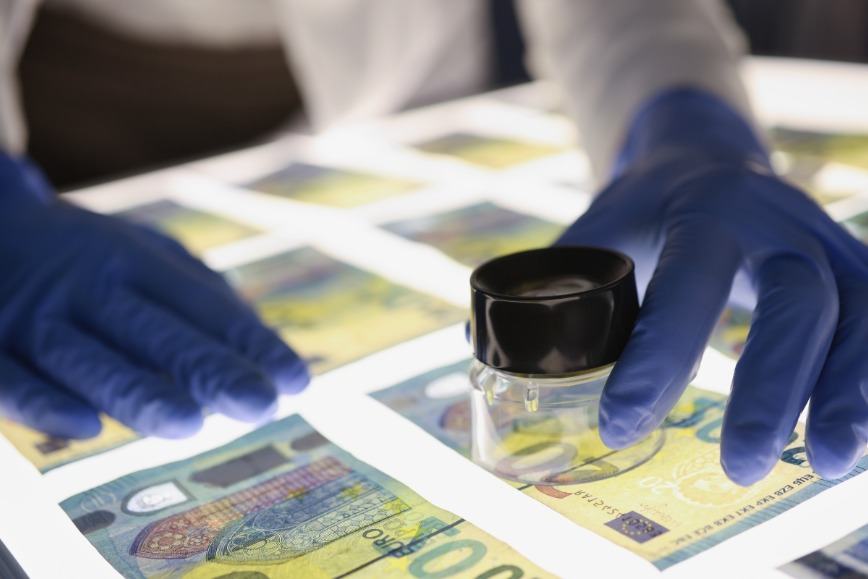
Central banks and suppliers of security features follow a process of adversarial analysis to test the resilience of features to counterfeiting and identify potential weaknesses. It requires the analyst to play the role of the counterfeiter and produce simulated counterfeit banknotes and their features in a laboratory.
But how does the analyst get inside the mind of the counterfeiter? Whilst we can’t see the counterfeiter, we can see what they have made. Forensic examination of counterfeit banknotes provides valuable insight into the materials and techniques that are used by counterfeiters to simulate all types of security feature.
Organisational structure against counterfeiting
Countering the counterfeiter through tasks such as public education and counterfeit analysis does not always lie exclusively with the central bank. Law enforcement agencies can lead on this, but whatever the structure, close co-operation is required. Some central banks draw on the extensive knowledge and capabilities of their commercial suppliers.
One of the original mandates behind the creation of Interpol was the suppression of international currency counterfeiting, a role that was enshrined in the Geneva Convention of 1929. Interpol runs a Counterfeit Currency and Security Documents laboratory, providing forensic support to investigators. This includes analysing, classifying and storing counterfeit banknotes. Interpol also acts as an information hub for police forces around the world.
Each member state of the European Union has a National Analysis Centre (NAC) that analyses counterfeit euro banknotes received in that nation. The NACs report into the ECB’s Counterfeit Analysis Centre, which coordinates technical and statistical information on counterfeits. The information stored in the centre’s database is shared with national police forces and other bodies involved in combating counterfeiting. The ECB also works closely with Europol, which has been designated as the central office for coordinating the protection of the euro, as well as with Interpol.
The United States Secret Service (USSS) collects data on all dollar counterfeits found in the USA and those seized or received in other countries. Authorised users such as foreign central banks and law enforcement agencies have access to the US dollars website for submitting suspected counterfeit currency and information about counterfeits on the USSS database.
Commercial banknote printers including Crane Currency and De La Rue provide a counterfeit analysis service to their central bank customers. CCL operates a Counterfeiting Laboratory within its R&D Centre in Wigton in the UK. It has a wide range of analytical equipment that is used to determine the characteristics, method of construction and mode of manufacture of counterfeit polymer banknotes for its central bank customers and law enforcement agencies.
Counterfeit analysis
Tracking counterfeiting trends provides insight about potential weaknesses of the current banknotes. Given counterfeiters work across borders, analysis of regional trends helps identify if a particular counterfeiting method is likely to be a threat in a specific country or region. . Smaller central banks with limited resources can turn to their commercial printers for this support. Interpol and Europol run conferences on counterfeit currency to provide information on the latest counterfeiting trends.
To gain the most reward from the time and resources invested in counterfeit analysis, there needs to be a feedback loop to the banknote design team and the R&D scientists who are developing new security features. Counterfeit analysis reports provide valuable information about which features are being targeted by the counterfeiters and therefore need to be made more secure.
Such analysis also highlights which features are more challenging for the counterfeiters, as they are either making poor reproductions or are not attempting to simulate them at all. These features should be at the core of new banknote designs.
Adversarial analysis: types of counterfeiter
Adversarial analysis is performed at different levels to reflect the perceived counterfeiting threat. This will range from a handful of photocopies made by an amateur to highly deceptive counterfeits produced in large quantities by professional gangs. The adversarial method, materials and equipment will vary depending on the counterfeiting level that is being evaluated. Adversarial analysis will consider the following categories of banknote counterfeiters:
Amateur. Generates low quality counterfeits by photocopying or scanning and printing genuine banknotes at minimum cost for casual spending. The counterfeits generated by this group are easily detectable.
Hobbyist. Uses home office equipment in addition to special materials purchased from craft stores or online retailers. The counterfeits produced by hobbyists are medium quality with innovative simulations of the security features.
Professional. Criminals or Organised Crime Groups (OCG) with skills in graphic design software and operating commercial printing equipment. Have resources for high end printers and additional equipment and materials, such as screen printing and foiling. Capable of producing highly deceptive counterfeits in large volumes.
Political state sponsored counterfeiting is not discussed here.
Feature reproductions by hobbyists are described as simulations because they are attempts to imitate the genuine feature using materials that are unsuitable for recreating the original. Professional counterfeiters will sometimes make the transition from simulation to emulation by using commercially available materials and equipment to reproduce the feature close to the quality of the original.
Setting up a counterfeit laboratory
The analyst needs a laboratory of equipment and materials to be used for simulation exercises. When testing features, the analyst will only use materials and techniques available to level of counterfeiter being assessed.
For example, for the amateur and hobbyist categories, a desktop all-in-one print, copy and scan device is appropriate. If the budget doesn’t stretch to the type of equipment that would be used by an OCG then the analyst will make a theoretical assessment based on their forensic examination of counterfeits.
Analysts should visit commercial print shows such as Drupa to source materials and keep updated on the latest printing methods and equipment that could become future counterfeiting threats.
Categorising counterfeit resistance
Central banks such as the Federal Reserve and the Bank of England have developed categorisation systems for adversarial analysis. The ECB uses a Resilience Grade scored from 1 to 6 to rank the counterfeit resilience of security features based on eight criteria, including simulated counterfeit attacks.
The eight criteria against which the ECB scores the counterfeit resilience of banknotes:
1. Complexity
2. Clarity
3. Wear and tear resistance
4. Equipment needed
5. Material needed
6. Material becoming available in the near future
7. People (knowledge, skills)
8. Simulated counterfeit attacks.
Whilst there are differences in approaches, they have in common the main criteria for assessment when comparing the simulated counterfeits with the genuine notes and features:
1. The level of difficulty to produce the simulation. This takes into account the effort or number of process steps, including preparing artwork files, the availability of materials and the overall cost.
2. The quality of simulation, ranging from low (easily detected by the majority of people) to high (only detectable by careful examination by a professional cash handler). The highest scores will only apply to emulations of features.
A scoring system is used to demonstrate improvements in counterfeit resilience through the product development cycle and for comparing features.
The samples are compared with the genuine notes and features to assess how deceptive the simulations are and with what level of difficulty they were produced. This can be scored on a grid, such as the one shown in Figure 1.

Machine readable features
Machine readable features are seldom targeted by the amateur and hobbyist counterfeiters. For the purposes of adversarial analysis they are considered at the professional level.
Central banks and those developing new features work closely with the manufacturers of banknote handling machines and detectors. Central banks such as the ECB, Bank of England and Federal Reserve include representative counterfeit simulations they have created in the banknote test decks provided to test banknote handling machines to see if they are correctly set up and are able to correctly identify both genuine and counterfeit banknotes. A list of approved machines that successfully detected all of the counterfeits is published on their websites.
Feedback loop to new product development
Adversarial analysis is a key task in the new product development cycle and the first testing should be conducted at the idea generation stage when the initial concept samples are available. This will identify weaknesses in the feature to be overcome in product development.
Further analysis will be conducted with each iteration of the product and compared with the previous results to demonstrate how the counterfeit resistance has been improved. The aim is to move from the bottom right quadrant of the grid to the top left quadrant (Figure 1).
Adversarial analysis is most effective when the central bank works closely with the supplier in the selection and development of features for their new banknote designs. The central bank will share with the supplier the counterfeiting threats they are experiencing and the supplier will demonstrate how effective the new feature is against the threat.
In some circumstances central banks will work together to share the results of their own analysis of a particular feature or counterfeiting methods. In 1989 eight central banks (Austria, Denmark, England, Finland, Norway, Spain, Sweden and Switzerland) formed the Reproduction Research Centre (RRC) located in the National Bank of Denmark. Over the years the membership grew with the addition of Australia, Belgium, Canada, Mexico, the Netherlands and USA.
The RRC was formed in response to the counterfeiting threat posed by the growing availability of colour copiers and scanners in the 1980s. The advantage of membership of the RRC is that it provides a lot more equipment and expertise than if each individual central banks had to fund this themselves. The members collaborate on the adversarial analysis of security features and share their findings at their annual meeting.
Adversarial analysis also has a part to play in auditing a current series of banknotes. Security features that were an effective defence against counterfeiting ten years ago may be less resilient today as counterfeiting methods advance. An analyst will review all the features in the banknotes using their knowledge gained from examining counterfeits and make recommendations about how security features can be upgraded or the notes redesigned.
Conclusion
Counterfeit and adversarial analysis are key weapons in the armoury of central banks and suppliers in the battle against counterfeiting.
Counterfeit analysis allows central banks to identify what criminals are doing and whether their banknotes are effectively protected. In this connected world criminals share techniques shortening the life cycle of features. Adversarial analysis indicates whether today’s notes are secure and informs selection of new features.
Central banks need to share information with suppliers to inform their new product development programmes.
Duncan Reid is a Counterfeit Expert specialising in the analysis of counterfeit banknotes, anti-counterfeit training, counterfeiting statistics and trends. He has 33 years experience in the currency sector including new product development, security thread manufacturing, papermaking and printing. He has provided services to central banks globally including forensic analysis of counterfeit banknotes and training on banknote production.
Subscriber content
Read the full article
Full access to Currency News articles, newsletters and archives.