Currency and the Metaverse
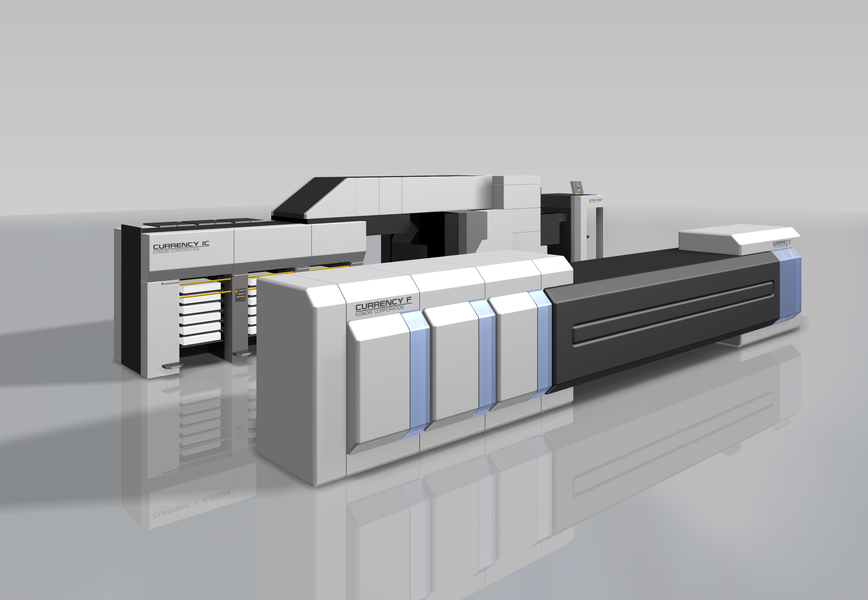
Among the customary technical presentations and product launches at conferences, the one given by Komori at the recent Global Currency Forum on the topic of the metaverse was very much ‘out of the box’. Here Steve Craig of Komori explains what the metaverse is, and how Komori is looking at harnessing it for banknote production.
Tech leaders believe the metaverse will be the next iteration of the internet. Rather than looking at a webpage on a screen, we will be able to interact as an avatar (a digital representation of ourselves) in online 3-D virtual environments. These virtual spaces will be accessible through the same devices you use today, as well as new types of equipment, such as virtual reality headsets and smart glasses.
Facebook has already changed its name to Meta in anticipation of an enhanced social media experience. Microsoft have launched their vision for a digital workspace with Microsoft Mesh – where everyone in a meeting can be present without being physically there, using personalised avatars and immersive spaces that can be accessed from any device, with no special equipment needed.
Sounds like science fiction? This is already happening today. A virtual mega yacht recently sold for $650,000 in The Sandbox metaverse. A plot of digital land sold for $2.3 million recently on the Axle Infinity site.
That said, the metaverse is still being developed, and it may be too soon to define what it means. The internet existed in the 1970s, for example, but not every idea of what that would eventually look like was true.
That’s because the term doesn’t really refer to any one specific type of technology, but rather a broad (and often speculative) shift in how we interact with technology and with each other.
To consider what this technology shift could mean for the cash industry, Komori have been working with the tech firm Synaptic Black, who are the developers behind the Infinity Metaverse.
The idea of virtual training and factory acceptance tests seems an obvious application for the technology, especially in a post pandemic world.
Another intriguing area for our industry is the idea of the digital twin (DT). A digital twin is a digital representation of an asset, say a printing press, hosted in the Metaverse. These digital twins are intended to support a bi-directional form of physical/digital control. Changing values in the digital twin can impact the actually physical machine, while real world data be received into the digital twin in real-time, enabling companies to run simulations, for example:
To improve efficiency by simulating changeovers
To run operator training
To predict prioritised maintenance, at the best possible time
To assess capacity and delivery requirements.
Early versions of digital twins were used by Nasa in 2002 to assist in the operation, repair, and maintenance of rockets, but use is now becoming more widespread – Honeywell reports that logistics firms are using DTs to test new floorplans and workflows in order to maximise efficiency.
Finally, the hybrid smart banknote has been discussed since the 2010s, with the idea that a physical banknote which has an embedded chip could be used to help central banks understand how cash flows and enabling the value of the note to be transferred digitally – the ‘empty’ note can then be refilled from your bank account.
With the Metaverse opening new opportunities for virtual commerce, perhaps the time is right for the analogue banknote to enter the digital age.
Subscriber content
Read the full article
Full access to Currency News articles, newsletters and archives.