SPARTAN: Transformational New Option at the Note/Coin Boundary
In last month’s issue of Currency News, we covered De La Rue’s D-Metric™ model and how a more logical denominational structure of notes and coins based on this model can improve cash cycle efficiencies. In some cases, this involves the replacement of low value banknotes with high value coins.
CCL Secure, however, has an alternative to this, namely SPARTAN™, which it describes as a ‘gamechanger’ in offering a new choice at the coin/note boundary and a genuine alternative to coining low denomination banknotes.
According to CCL Secure, the SPARTAN banknote has been engineered specifically for the note/coin boundary and is the result of researchers creating not only a brand new kind of polymer but also reimagining the banknote production process.
‘The challenges of the note/coin boundary are well-known,’ says CCL Secure’s Director of R&D, Marketing and Design, Dr Tim Berridge. ‘High transaction velocity leads to high costs of replacement and pressures to move to coin, with all the associated disadvantages of high material costs, high handling costs, high storage and distribution costs, and general public dislike for coins. SPARTAN addresses all of these issues. To create an effective solution it became very clear, very early in the process, that we needed to engineer an entirely new kind of banknote.’ Two factors are seen as key to the success of the new substrate.
First is the innovative use of materials and science in developing both a new polymer film and new inks. The substrate and inks have been developed to work together and form an ultra-tough banknote that CCL Secure says is far more resilient than any other banknote currently available. This ‘lock and key’ approach has been made possible by the close working relationship and joint R&D activity between CCL Secure and its sister company Innovia Films.
Second is that SPARTAN banknotes are produced in a single manufacturing process, significantly improving the efficiency and time associated with the production process as well as targeting exceptional durability that makes it longer lasting – even in high transactional velocity environments.
A banknote design is built up of many layers that come together to form a cohesive, aesthetically pleasing, and secure final product. These layers are produced through a series of processes – typically offset, intaglio, screen, and letterpress. While the process used for producing SPARTAN is different to that of traditional banknotes, the design development process is very similar. A SPARTAN design is also built up of many layers, each one adding complexity and security. The designs are created using dedicated banknote design software that enables the use of complex patterns and fine line artwork that is familiar on banknotes around the world.
Portraits and key iconography are converted into keyline artwork in the same way as an intaglio portrait. Consequently, says CCL Secure, SPARTAN banknotes have a look and feel that will be familiar to the public – to aid public acceptance - but also have an ultra-durable construction to enable the note to survive at the note/coin boundary.
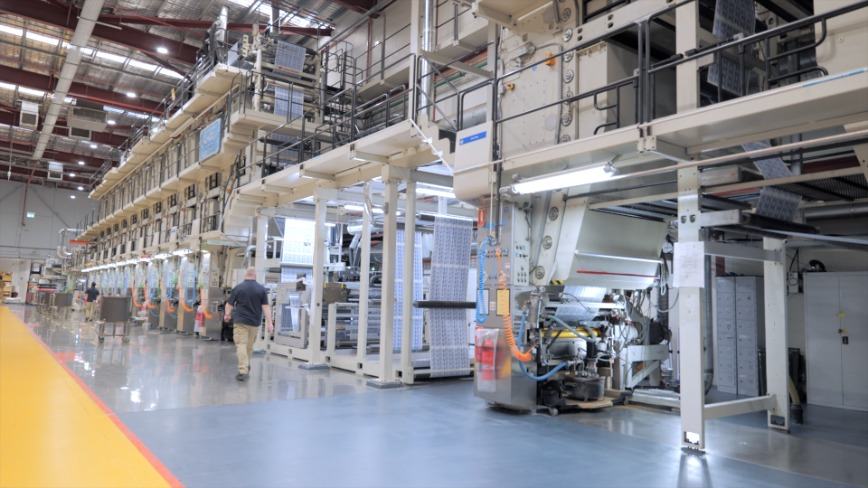
SPARTAN banknotes are printed on a wide web gravure printing press that has been significantly upgraded. CCL Secure has used its 30 years of experience gained from producing GUARDIAN™ polymer substrate to enhance the capabilities of gravure printing. Each SPARTAN banknote starts as a continuous web of Opacity W film onto which layer upon layer of banknote artwork is applied through multiple printing stations.
Each layer of the design is laid down in precise registration. In addition to the high levels of registration control, each layer is also inspected for quality using a high-speed inline quality inspection capability, developed specifically for SPARTAN. Every detail is inspected and checked to ensure quality, and if a defect is identified, the position and location of that banknote is then tracked so it can be removed.
Each banknote has a unique serial number which is printed as part of the inline process. The style and numbering sequence can be aligned to the current banknotes in the same currency family. Each number that is applied is also checked to ensure that the correct number has been applied, that there are no repeat numbers, and that the print quality of the number is acceptable.
‘A SPARTAN banknote is more than what you can see with the human eye’ says CCL Secure. During the production process, special coatings are applied to give them their unique feel and tactility. They are also provided with an overcoating to add further protection and enhance their durability.
All of which means that SPARTAN notes are produced in a single pass. In simple terms, a roll of Opacity W polymer is at the start of the printing process and finished SPARTAN banknotes – ready for delivery and issuance – are at the end.
In addition, the production process means that counting, reconciliation of notes, and traceability are all built in. Security is provided through both covert and overt security features that are applied during the production process, while Opacity W polymer can be forensically authenticated.
Finally, as with banknotes created using GUARDIAN™ polymer substrate, all SPARTAN banknotes are fully recyclable.
‘SPARTAN represents an entirely new form of banknote engineered for the specific purpose of the note/coin boundary’, concludes Dr Berridge.
‘We believe it’s the most significant new development in banknote technology for a generation and will transform the way in which central banks and issuing authorities take their note/coin boundary decisions. By providing an ultra-durable, cost-effective alternative to coining – and reducing the cost of the banknote option – we’ve created a new way in which all the benefits of polymer can be used.’
Subscriber content
Read the full article
Full access to Currency News articles, newsletters and archives.