All Change at the Bangko Sentral ng Pilipinas
There is a lot going on in the Philippines at the moment. The Bangko Sentral ng Pilipinas (BSP) combined its payments and cash functions last year as part of its push toward digitalisation and financial inclusion, and this month is embarking on a trial circulation of polymer. It has also created an inventive, and award winning, system for cash circulation and is in the midst of specifying and building a new printworks and cash centre with sustainability at its core.
All of this in an archipelagic country with a landmass covering 300,000 km, made up of more than 7,500 islands and a population of nearly 110 million, 50% of whom are unbanked. The BSP’s digitatisation strategy is aimed at rectifying this, creating a more financially-inclusive society and, at the same time, improving on its cash provision in terms of durability and accessibility.
Currency News™ caught up with Deputy Governor Mamomet Tangonan at the recent Banknote & Currency Conference to find out more.
Q: First of all, tell us a little about yourself, and your role at the BSP?
A: I joined the BSP about a year ago, in 2021, as Deputy Governor of the Payments and Currency Management sector. I handle both the digital payments side and the physical payments side, ie. banknotes. We also print security documents and have gold operations, so I look after all that.
My role is really to address that interplay of digital and physical currency.
Perhaps I was selected because of my background in digital financial services, digital payments, before joining BSP. But I’m actually not new to the BSP because my previous role was as an implementer of USAID projects.
My team were regularly asked to put together this framework for national digital payments and it involved restructuring the governance, and the payments industry itself, to make sure that there is competition and interoperability, meaning customers can transfer funds from one financial institution to another, so we helped the BSP put together that framework. Perhaps that was recognised, because of the successful uptake of digital payments in the Philippines.
It was providential that we implemented that before the COVID pandemic struck because we were locked down and no one could step out of the house, so the only way you could access goods and food was by using digital payments.
Q: Your arrival was part of a major reorganisation of the cash and payment functions at the BSP, which were combined. What was the objective of these changes?
A: Due to the big push towards digital transformation, digital payments, the Monetary Board deemed it appropriate to have a dedicated sector for that.
The three pillars of the central bank are price stability, financial stability, and a safe and efficient payment system.
There is a sector doing the monetary, and a sector doing the banking supervision, but there was no dedicated sector taking care of digital payments and the physical currency. The Monetary Board deemed it appropriate to create a new sector, especially with this big push on digitalisation, called the Payments and Currency Management Sector (PCMS).
Q: With this big push to digital, what has been the impact on cash trends in the Philippines?
A: Overall, cash is certainly continuing to decrease, but recently in our currency forecasting models, we’re beginning to see the impact of digital payments on cash and it’s becoming more pronounced.
Digital payments comprise about 20% of total retail payments transaction volume, so it’s growing, making its presence felt in the whole currency demand forecasting model. It’s meaningful but not substantial yet.
Q: The Philippines is a huge country with many islands, big urban centres, and a significant rural population – how complex is the distribution and the management of cash circulation, given those considerable geographic challenges?
A: It’s more complex than continental countries because we have to cross seas to deliver cash. We have a network of about 25 regional offices and branches to do this. We principally distribute cash through the banks, but our own branches become the last resort for cash when it comes to disasters.
These branches normally service the withdrawals of the larger commercial banks, because the distribution goes down the food chain – from the BSP to the commercial banks and then the smaller banks. But we’ve seen with some natural disasters that when the commercial banks couldn’t, or elected not to, operate, the smaller community banks had to run to our branches to source their cash.
So there’s clear role for us in distribution. In addition, the number of ATMs has grown remarkably over the last few years and have been a reliable source of cash for the people, especially during most days of the year when there’s no disaster.
Q: And, of course, you had a very inventive and creative approach to keeping cash circulating during the worst of COVID with the Cash Service Alliance (CSA).
A: We implemented the CSA in October 2020. We had previously been thinking about efficiency but then, during the height of the COVID lockdowns and infections, our people were either too ill to come to work or didn’t feel safe, especially with public transport. We understood that but we had to continue servicing withdrawals, so we implemented the CSA that October.
We rolled out the system so that the banks could see each other’s cash positions, and if a bank has a surplus and they need that denomination, then they make a trade.
That worked very well, we were just targeting a 20% share of total withdrawals from that, but we got 53% from that, and this initiative will become permanent.
Q: Looking at coins now, is the BSP’s coin recirculation programme still going? Are you still finding that you have shortages?
A: Currently, we have around 37 billion pieces of coins in circulation, which tells us that they are hardly circulating. Once they are withdrawn they are used once or twice, then stored somewhere.
We are coming up with a programme to deploy cash deposit machines where people can bring their jars of coins and they will get the equivalent amount by credit in their accounts, or a voucher if they prefer.
This programme is already under procurement and will begin by the third quarter of this year.
Q: And now to banknotes, and the polymer trial. What’s the rationale behind it?
A: We’re doing a limited circulation test. We went through this very carefully, did our best research, and collaborated with other central banks to confirm the lifespan and other benefits of polymer, such as environment, cost effectiveness, and security.
But before plunging into it head on, we would just like to prove that these things that we read about in other jurisdictions have the same behaviour under Philippine local conditions, which are tropical and humid.
"There’s clear role for us in distribution. In addition, the number of ATMs has grown remarkably over the last few years and have been a reliable source of cash for the people. "
Q: How long is the trial going to last for, and how many notes?
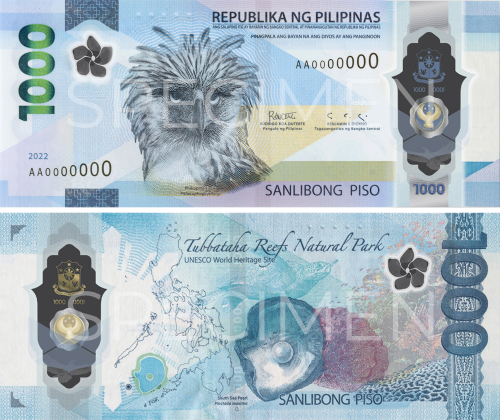
A: We’re getting a few hundred million polymer banknotes for the circulation. Right now, our paper notes last around 18 months. If the unfit polymer notes that come back have lasted two and half times longer in circulation, then that’s our measure of success and will have proved that the trial was worth it.
Q: And why the 1,000 piso denomination, which is the highest?
A: Because it is the most frequently used. The denominational preference has shifted steadily from 2014 from lower denominations to the P1,000. We believe that is the result of increasing the number of ATMs. The ATMs principally churn out P1,000 notes, because for the banks and CIT companies it’s more cost effective to put them in than loading and reloading frequently with P500, P100 notes and so on.
Q: Do you not run the risk that because it is a high denomination that people won’t use it and they’ll see it as a collector’s item?
A: Yes, particularly with the initial issuance, the behaviour will be like that. That is why we ordered a few hundred million – the ratio of paper to polymer notes will be 50/50 – so that people will see that there’s no scarcity of this banknote and so they should make use of the value in it.
Q: Presumably with this trial you have the ATM operators and the banknote sorting machines manufacturers lined up to be able to handle the new note?
A: Correct, we have them on board. We promised them that we would issue it to them first so that they could prepare for it before it was issued to the public.
Q: The design is different to that of the paper note? Can you explain why?
A: We’ve lifted the same design elements from the Enhanced New Generation series, but we replaced the image of the three heroes with that of the Philippine eagle. We felt that we could take advantage and optimise the benefits of the security features available with the substrate, and the design elements.
Also, in the current crisis and difficult time, we want to highlight the lightness of the Philippine eagle with the Filipino spirit in the country. The Philippine eagle is very strong, and is able to soar above storms. It’s a strong message to the people that times are hard, but we will soar above the sky.
Q: Assuming the trial does achieve all of your objectives, will all of your banknotes switch to polymer, or is that a decision to be made further down the line?
A: We will present the result of the limited circulation test and make a recommendation to the Board, but I don’t want to pre-empt the Board’s decision; they decide.
Q: Moving now to your new printing plant, and the move from the current premises in Quezon City to New Clark City, which was announced a couple of years ago, how is this progressing?
A: It’s progressing very well. We’re just about to award the architectural engineering to the winning firm, so they’re given six months to come up with a detailed design, which will be the basis of awarding the general contractor to build the facility. The target for completion is anywhere from 2-3 years.
This is for the restricted zone, because the whole property where we’re going to build the plant is around 33 hectares; the production facility will sit on a 10 hectare property inside that.
Q: Will everything go in that complex?
A: All production will go there. But we have allocated space in our head office in Manila for storage and for cash operations for the capital region. The rest of the country’s needs will be serviced by the new facility in Clark. The idea is that, should there be a major disaster, then one of the two sites will be able to continue.
Q: Will you still maintain the existing production facility?
A: The current thinking is no. But we still have to recommend how best to dispose of it; either we sell the property, or we go into a joint venture. That’s still unclear.
Q: As it’s a brand-new facility, have you designed in sustainability?
A: We’ve built that in from day one. Because BSP has adopted the ESG compliance, so it will be a well accredited facility. The other one is the ‘Verde’ (green) standard; it will comply with that too.
Q: How are you encouraging cash cycle stakeholders to reduce their environmental impact? Would you say that the CSA helps with that?
A: Yes, because instead of cash coming back to BSP and us having to print more of it, polymer notes stay out there. It really maximises the lifespan of the banknotes, and coins.
We also aim to achieve zero waste. With the paper banknotes we would shred it, and we’re talking to circular economy companies who are willing to purchase it and extract the plastic resin from it and make chairs, bricks, and other useful materials, thereby not disposing of anything in the environment.
Q: You straddle all aspects of payments. What is your vision for payments in Philippines in say five or ten years’ time?
A: We have an intermediate goal of achieving a 50% share of digital payments over total retail payment transactions by 2023, so if I add seven more years to that, then continuing that trajectory will probably put us nearer to a 70% share.
We believe that there’s a segment of the public that will stick with cash, so we will continue to manage cash and make sure it’s available to those who need it when they need it. But we will continue to promote digital payments because they do have benefits, especially since the country still has a rather low level of financial inclusion.
In 2019 we were at just 29% account ownership and right now we estimate that it’s 50%. But that’s still half the adult population having no access to formal credit and formal savings. We would like to bring them in and since payments is the leading financial service accessed by people (85% of our people use payments, much more than the other financial services), we are using that as the entry point for financial inclusion.
Cash in Circulation in the Philippines
According to the BSP’s recently-published annual report, the value of cash in circulation (CIC) in the Philippines rose 21.4% in 2020 but fell 6.7% in 2021. The volume fell 2.8% to 41.8 billion pieces.
The BSP believes this was driven by returning economic activity allowing money held as a precaution to be released, and the increasing availability and use of alternative digital payments for transactional purposes.
Year on year the volume of notes withdrawn fell 27.9% in 2021. Coin volumes rose 9.5% in volume and 117.2% by value.
Subscriber content
Read the full article
Full access to Currency News articles, newsletters and archives.