Is a Fully Circular Approach to Banknotes Possible?
At the Banknote & Currency Conference in February, Swiss substrate manufacturer Landqart revealed new research it has been carrying out on how to dispose of banknotes at the end of their life in an environmentally sound way.
Recycling banknotes is a challenge because they contain elements such as taggants, security fibres, foils, threads and inks, all of which would ‘contaminate’ the new banknote substrate they are used to make. As a result, cotton-based banknotes are often burnt in energy recovery furnaces generating electricity.
Landqart recovers as much fibre as it can and, in accordance with Swiss law, supplies what is left to a local incineration/generation facility. That facility then supplies it with steam to heat the drying machines used in the paper making process.
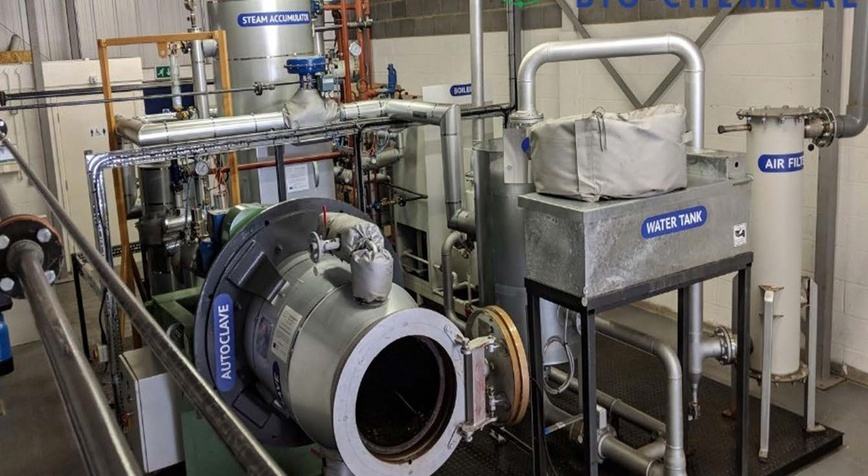
Outside of the banknote industry it is common for organic waste to be turned into energy. Systems have been designed to work as part of mainstream recycling channels, for example as a solution for the disposal of single use coffee cups. Landqart has been investigating the use of autoclave technology, which eradicates micro-organisms by raising the temperature and pressure in relation to ambient pressure and/or temperature. The result is a homogeneous, sterile, biogenic material which can then be used for other purposes.
Landqart has worked with Hughes Energy, which has developed an industrial scale system to take solid unsorted municipal waste and, using the Wilson System®, to turn it into green energy. The output from the organic material is a sanitised fibre that can be used for biochar gasification, pyrolysis biochemicals and biofuel anaerobic digestion. The process is, mainly, a closed system, with controlled emissions for the low level of emissions that there are.
In order to understand whether this process would work for banknotes, Landqart worked with the Biorenewable Development Centre (BRC) in the UK. The BRC does open access scale up R&D to convert plants, microbes and biowaste into high value products. Landqart tasked them with determining whether a banknote can be autoclaved, and evaluating the applicability of the Wilson System and the cellulosic material created to see whether it is suitable for local use or sale internationally.
The trials tested regular cotton paper and Durasafe®.
The trial work
The initial work ran into problems because there was a post-print varnish protecting the banknotes, so the steam used to raise the temperature did not penetrate the paper. A number of trials established that the use of either sulphuric or acetic acid in the process solved this problem. The conclusions were that:
The process can create cellulosic fibre suitable for pelletisation for use in biomass boilers.
The fibre can be processed further for conversion to other products.
Analysis of the captured condensate showed that it was non-toxic and safe to dispose of without additional measures. They were in line with the standard for biomass pellets.
The biomass fuel pellets produced met the standards of BS EN 17225-6 and had a value of 15.5MJ/kg, the minimum requirement to qualify being 14.5MJ/kg. This level of calorific value is not revolutionary but works well. One could run a power station with such pellets, if only there were enough banknotes!
Alternative uses for the fibre?
While cotton is 99% cellulose, this is constructed of glucose molecules. The autoclave hydrolyses the cotton, creating hydrolysed cellulose. When additional acid is added, it is possible to break down the cotton to pure glucose, which is a tradable commodity since it can be used as a base for fermentation, eg. the production of ethanol, acetone or bio-butanol.
For the Durasafe product there was not enough polymer present to recover it for re-use. Instead, the autoclave process breaks it down. It is unlikely that acetone or ethanol can be made from Durasafe based waste because getting a sufficiently efficient distillation would be too difficult. It would though, be perfect for adding to cardboard manufacture, insulation, etc.
Scientists from the US Department for Agriculture (USDA) reviewed the results. Their conclusion was that if the level of hydrolysis is controlled, it is possible that other products could be produced such as cellulose acetate, which is used in the textile and personal hygiene industry. It could be an alternative to carbon black in the plastics industry.
The cellulose fibre from processed, shredded notes can also be used in premium packaging for wine cases, as a strengthening agent in plastic recycling for building materials and pallets, to influence mechanical properties for eco-plastic products, as a replacement for natural bio-products used in composite car parts and as an insulation product.
Landqart has had full spectrographical analysis of the material and condensate carried out to get a third opinion, and it confirms these results.
Next steps?
Landqart now wants to initiate research into whether the fibre can be used during the production of banknote and security paper, creating a fully circular system. This last research needs to establish whether and what compromises are needed if waste note material is to be used in new banknote paper.
Subscriber content
Read the full article
Full access to Currency News articles, newsletters and archives.