
From Costa Rica to Meta’s Latest Plasmonic Banknote Security Feature
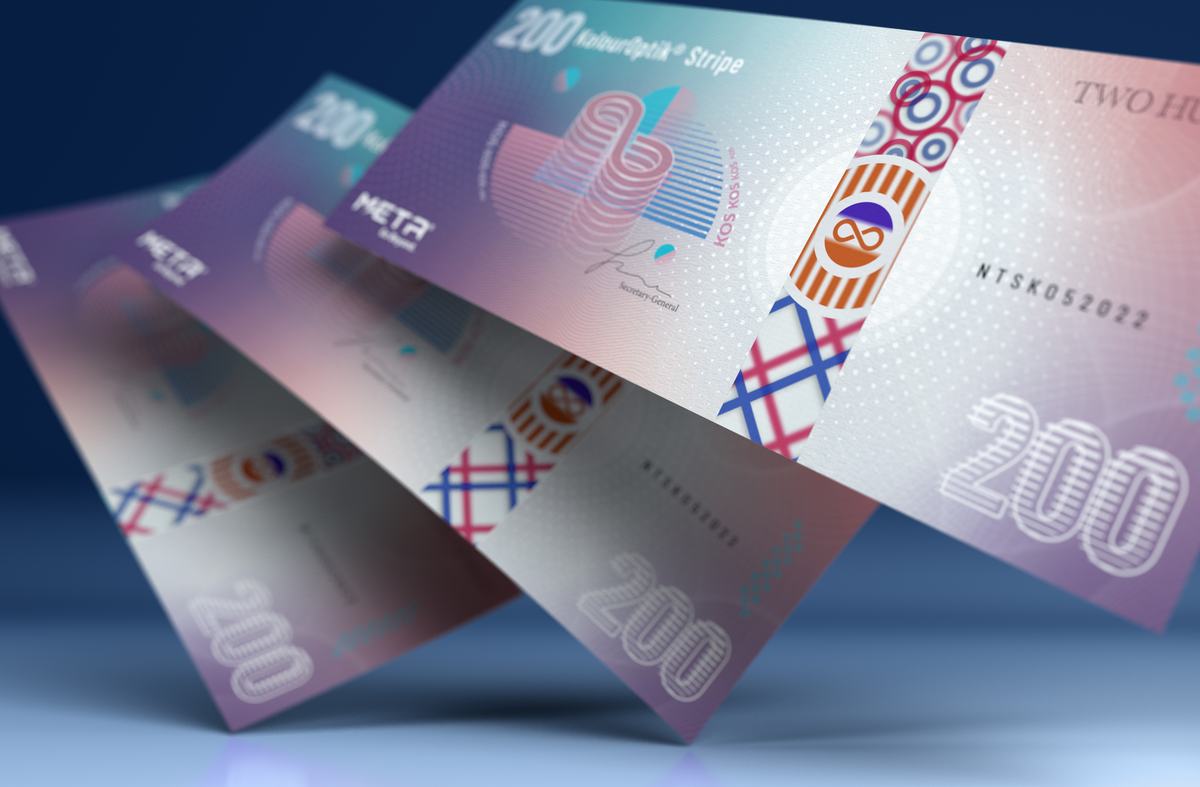
Meta Materials Inc (previously Nanotech Security Corp) has been a pioneer in banknote OVD technology for the past decade with innovations in micro-, nano- and now plasmonic structures. The company has also developed in-house secure foil production so that it can offer banknote stripes direct to customers.
The physics of surface plasmons deals with phenomena that occur at an interface, or boundary, between a dielectric (an insulator whose electric charge can be shifted without flowing) and a metal (a conductor whose electric charge can flow).
Under certain controlled conditions, energy, in the form of electromagnetic excitations, moves along the interface between the dielectric and the metal in the form of a wave. These so called evanescent waves are trapped and can only move in particular directions. The plasmons can be controlled through careful modelling and application of, amongst other things, the dielectric and metal layer thickness in a ‘sandwich’ structure.
When the sandwich structure is applied as a device to a security document, it allows light that falls on the surface of the device to be controlled in terms of its wavelength (allowing you to control the colour) and amplitude (giving rise to the intensity, or brightness) of the colour generated.
In the recent webinar ‘Producing the World’s First Fully Plasmonic 3D Animated Banknote Security Feature’, Meta’s VP of Product Management, Neal Skura, and VP of Technology & Innovation, Clint Landrock, explained how they were inspired to create Meta’s KolourOptik® Stripe and its toolkit of customisable authentication effects with 3D parallax.
A personal journey
Everyone’s route into science is different and Clint took the audience on his personal journey exploring the jungles and volcanoes of Costa Rica as a young grad student. ‘I was inspired by how the blue morpho butterfly’s brilliant colours never faded or dulled under the dark canopy. This curiosity drove me into looking deeper into how these beautiful butterflies managed this feat of evolutionary engineering.’
What’s interesting about this particular butterfly is that its wings are actually colourless, meaning that there are no pigments or dyes creating the colour. If you look at them through a light source, they are actually transparent. The colour is generated by a combination of macro, micro and nanoscale structures on the wings that combine to filter the light, except for the light in the blue part of the spectrum. The blue light is captured and reflected back, and this is what makes the wings appear as a very bright blue colour, even in dark environments.
Clint explained that Meta has followed nature’s multifaceted structural colour approach. They have combined macro size, unit cells of microscale structures to create the foundations of 3D display pixels, and then combined those with nanoscale plasmonic meta structures that, like the blue morpho, filter out light they don’t want. This allows them to capture and select the colour of light they want to use for a given image subpixel.
These nanostructures are small, more than five times smaller than the wavelength of visible light, and so densely packed that the distance between neighbouring structures is much less than the wavelength of visible light.
Being able to manipulate light at the wavelength level is one thing but, as Clint explained, to achieve visual authenticity in a feature requires full colour, movement and 3D parallax, and to achieve the best levels of authentication requires a combination of all three. By combining plasmonic colour subpixels onto microscale pixels, Meta can produce a visual authentication feature that can combine these three vital elements in a single origination.
Sustainability – doing more with less
This fits well with Meta’s sustainability ethos of doing more with less, as mass replication of the feature requires a single embossing layer, which in turn reduces the amount of base materials needed to produce KolourOptik® Stripe.
Neal Skura took over the theme of banknote authenticity from Clint, summarising that optical features need to be immediately obvious and engaging but at the same time complicated enough that not just anyone can make them, and that it should be impossible to simulate the effects with other technologies.
Neal went on to explain that its ultra-thin surface applied form factor makes KolourOptik® compatible with all banknote substrates in production equipment, removing the risk of banknote distortion and without requiring specialised application machinery or changes to existing processes. The ultra-thin form factor derives from its single layer of embossed structures, reducing the number of production variables and simplifying both the manufacturing and the application processes.
‘There’s no need for laminated layers of lens arrays, focal spacers or inks and dyes. Importantly, because we’re not using inks or dyes, multiple colours can easily be included in design without additional processes or costs,’ he said.
High volume production
Meta has been innovating not only the nanostructures and plasmonic effects, but also the production processes and tools required to bring their technology into high volume manufacturing.
Manufacturing the KolourOptik® Stripe requires industrialised nanofabrication processes that ensure that the fidelity of the nanostructure is preserved in every step, so that the visual effects remain consistent and true to the intended design.
It should be made clear, though, that while the nanostructures and production processes are innovative and proprietary, the resulting finished trade product is in a standard surface applied format.
In the past year, Meta has successfully qualified its in-house volume production capabilities, demonstrated industrial application of over 100,000 stripes onto banknote paper and completed durability tests with multiple test partners with good results.
Subscriber content
Read the full article
Full access to Currency News articles, newsletters and archives.