Lesotho's Green Banknote Meets the Kingdom's Sustainability Goals
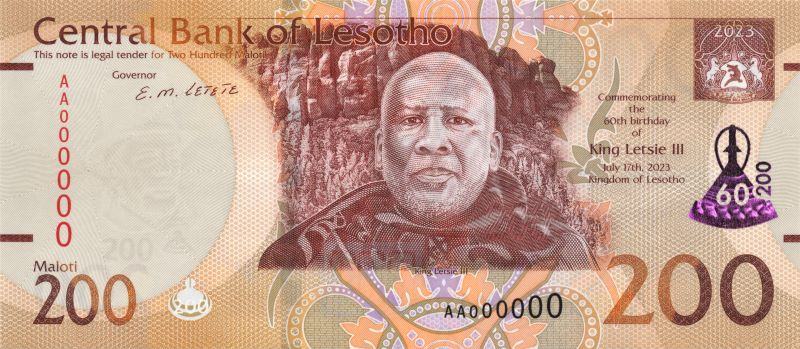
On 17 July the Central Bank of Lesotho unveiled its first Green Banknote, in commemoration of the 60th birthday of the King of Lesotho, His Majesty King Letsie III, who has reigned since 1996. The highest denomination, the 200 maloti, was selected for this auspicious occasion. The front of the regular 200 note features three royal family members, and now the commemorative note has been redesigned exclusively with the portrait of the ruling King.
It is widely known that the King is passionate about agriculture and the environment, and the government is focused on implementing strategies to conserve the environment, bio-diversity and nature, and improve sanitation. The Green Banknote was selected to mark the event as it is made from sustainable renewable regional sources (Cotton Made in Africa), has a lower carbon footprint and is more durable than standard cotton banknotes.
The Kingdom of Lesotho is an enclaved country surrounded entirely by South Africa, with a population of 2.2 million, an area of just over 30,000 km2, and one of the highest literacy rates on the African continent. Its capital and largest city is Maseru. Lesotho is renowned for its traditional Basotho culture and clothing such as the Mokorotlo, a conical straw hat which is the national symbol of the country, and appears on the Lesotho flag as well as banknotes and licence plates.
Interestingly, Lesotho is also known as the ‘Roof of Africa’, or mountain kingdom. It is officially the earth’s highest country, with the lowest point of the kingdom over 1,000 m above sea level. Such terrain has generated lots of interest and competition amongst mountain bikers, skiers and adventure travellers.
The Lesotho currency is the loti (plural maloti), subdivided into 100 lisente, and takes its name from the Sesotho word for mountain. It is pegged to the South African rand on a 1:1 basis through the Common Monetary Area, and was first issued in 1966, the year that the country gained independence from Great Britain, albeit as a non-circulating currency.
In 1980 the first banknotes and coins were issued, the former in denominations of 2, 5 and 10 maloti. 20 and 50 maloti notes were added in 1981, followed by 100 and 200 maloti notes in 1994. A new series was issued in 2010 and upgraded in 2021 with smaller notes, tactile markings, enhanced security features and a special varnish.
Whilst the Bank has previously issued gold and silver commemorative coins to mark national events, such as the King’s coronation and his 50th birthday, this is the first time it has issued a commemorative banknote.
The key design feature for the front of the 200 commemorative maloti is the portrait of King Letsie III, in intaglio. In addition, the Mokorotlo is featured to the right of the portrait, along with the national coat of arms. The back of the note remains the same, depicting a traditional Lesotho merchant on horseback. The watermark is a portrait of King Morena Moshoeshoe I, the first King of Lesotho.
The key security feature, meanwhile, is a 4mm dynamic RollingStar® i+ ‘Moon’ thread on the reverse. When tilted, perfectly aligned circles in an alternating pumping sequence can be observed, incorporating colourshift from magenta-to-green. The cleartext ‘200’ and ‘CBL’ is visible, and the thread is secured with MultiCode™.
There is a green aspect too, as the thread features 70% recycled PET for the carrier foil.

Matching the thread dynamics and colour shift of the thread is the Mokorotlo in SPARK Flow® Dimension alongside the portrait of the King. The image also shows the numerals 60 for the King’s birthday and 200 for the denomination.

Notably, some other banknote components have embraced sustainability. The substrate – a greener version of Hybrid ADDvance® – is composed of 75% ‘Cotton Made in Africa’, and 25% FSC®-certified wood pulp, making it the first banknote to be made with the Cotton Made in Africa certification.
Furthermore, the substrate is protected by thinner layers of PET film, reduced from 6µm to 4µm on each side (30% less plastic and 5% less weight). Additionally, mineral-oil free inks were used for the Simultan printing.
5 million of the notes are being produced and, unlike the previous commemorative coins, are intended for general circulation. They will be issued in the next couple of months.
Subscriber content
Read the full article
Full access to Currency News articles, newsletters and archives.