
· 4 min read

Neurocash – A New Way of Designing Cash

Astrid Mitchell
Astrid Mitchell · Editor
Neurocash – A New Way of Designing Cash

Miguel López, Research and Development Unit Manager in Banco de España recently presented a new way of designing cash, Neurocash, at both the EMEA and Latin American High Security Printing conferences.

He introduced his presentation with the statement that a banknote series, to be successful, must meet many different requirements. Above all, it should be difficult to counterfeit but at the same time be attractive to citizens who should identify with their currency and be proud to use it. It should have easily identifiable public security features that enable public trust, as well as machine readable features that enable counterfeits to be detected and removed.

In addition, a banknote series should have low manufacturing costs, be durable, environmentally sustainable, innovative, and fulfil stakeholder requirements.

Mr López pointed out that this is a significant challenge for any central bank, and many methods have been developed to best meet both the public and technical requirements. While both are very important, he maintained that it is essential that the public are engaged and positive about their banknotes, and this presented perhaps the greatest challenge.

In order to do so for a new series, the Bank’s Cash Department, in collaboration with the University of Valencia’s Immersive Neurotechnologies Lab (known as LENI), have developed a process they named the ‘Neurocash© Methodology’. The former provides the cash technology expertise and the latter the neuroscience and artificial intelligence expertise, and their cooperative work started in 2017.

Different disciplines and tools

Neurocash takes into account different disciplines and tools, for example neuroscience, neuropsychology, machine learning, AI and several techniques that are only available today due to the development of sensors capable of measuring bio-signals. In addition, standard design aspects such as graphic design, the integration of security features and communication campaigns are involved.

Since the work started, several studies have been undertaken to develop and improve the Neurocash Methodology.

Traditional perception studies for banknotes have been based on questions and answers obtained through questionnaires and in person interviews. But advances in neuroscience have shown that the information obtained by these methods is only related to the conscious mental processes and does not give a complete picture of the perception of the public.

For a more complete understanding, it is also necessary to have information on the unconscious processes, as these govern our activities, feelings, behaviours and decisions. The importance of this information is that it is not biased by the participant. The results recorded by sensors, the bio signals, provide unbiased data that is analysed in detail.

Two kinds of bio signals are measured in the Neurocash Technology. Human behaviour is monitored by eye tracking, facial coding and human behaviour tracking of each participant.

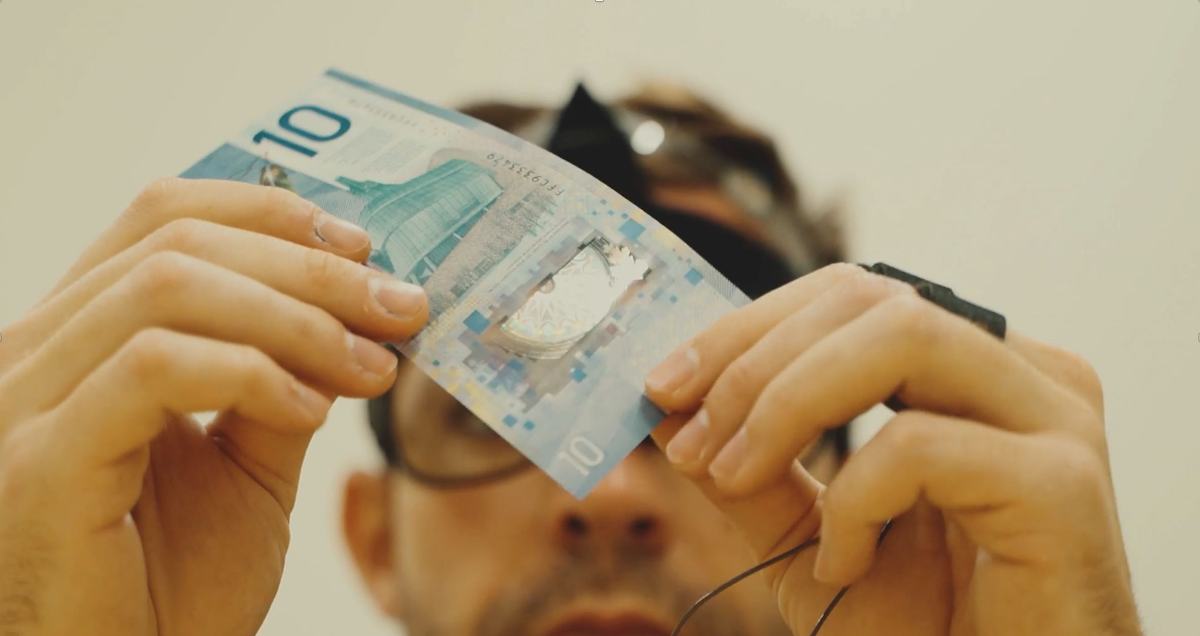
To measure the physiological response of participants, more sensitive sensors are used – electroencephalogram (EEG – the spontaneous electrical activity of the brain) and electrodermal activity (GSR – skin response) and heart rate variability (HRV) – when they are looking at and tilting a banknote.

Different items such as real cash, conceptual cash, security features and even communication strategy can be evaluated. In each case, a report is produced by analysing the results from the bio signals captured by the sensors using the algorithms developed by the research team.

In the case of a new banknote series, a score (for each aspect being evaluated) is obtained in terms of different neurometrics based on the cognitive responses of the individuals for, eg. visual, emotional and security aspects. However, also considered are the answers provided by the traditional methods. In this way, a more complete picture is produced.

Finally, a report is produced as a tool and additional input for the decision-making body, to enable, for example, the choice of the best design.

Areas of application

According to the developers, there are four main areas in which Neurocash can be used for banknotes, and for each category numerous opportunities are envisaged: 

1. Neurodesign – virtual prototypes, security features (eg. to determine the best integration of the security features into the design), concept banknotes and new and updated series.

2. Production – perception of a production defect (eg. determine whether the defect is sufficient to justify destruction of the notes affected), expert vs non-expert quality control classification.

3. Circulation – discriminability studies, effectiveness of security features, context effect on detection.

4. Communication – responses to brochure, video campaigns, training material, web content, interactive content.

Advantages of Neurocash

According to Miguel López, the advantages of using the Neurocash Technology fall into four main categories:

  • Public perception (implicit and explicit responses, impartial information and AI analysis)

  • Improvement of design and effectiveness of security features (data driven decision making)

  • Analysis of counterfeit resistance (perception studies of legal and illegal banknotes)

  • Cost reduction in design, production and circulation (perception studies of production defects by public and virtualisation of design).

In each case the method provides unbiased data based on the unconscious mental processes. Such information was previously unavailable but now, combined with information from traditional perception analysis, decisions can be made with a much greater chance of success.

The next steps in the project are the development of a portable neurokit so that studies can be carried out anywhere in the world, the application of the methodology in other cash fields, and the virtual neurodesign of cash with the support of virtual reality headsets, haptics, and other XR (extended reality) technologies.

Mr López concluded by saying that they are willing to collaborate with any central bank or issuing authority interested in using the technology.

A video promoting and explaining Neurocash will shortly be available on the Banco de España website.

Subscriber content

Read the full article

Full access to Currency News articles, newsletters and archives.

Sign Up to Currency News Weekly

Receive regular updates on the latest news and articles posted on our website.