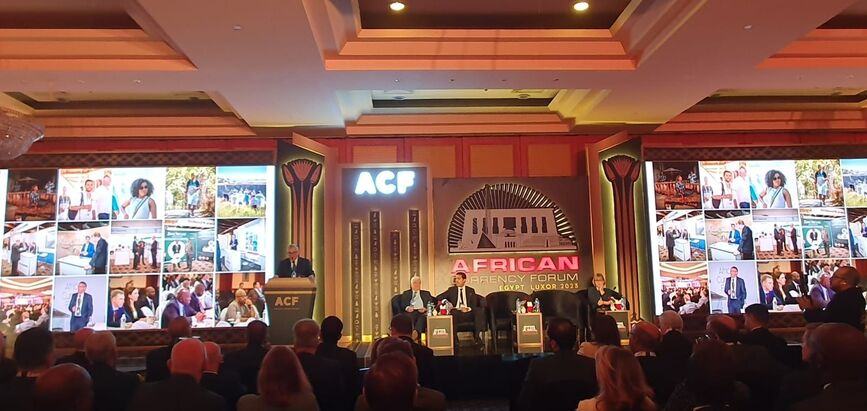
All Eyes on Africa as Egypt Hosts Spectacular ACF
The COVID-delayed African Currency Forum (ACF) finally took place two years and a few months later than originally planned in Luxor, Egypt from 15-18 January, attracting 305 delegates from 46 countries, including 25 central banks and state printworks from Africa itself.
This Forum was hosted by the Central Bank of Egypt (CBE) Printing House on behalf of the Association of African Banknote and Secure Document Printers (AABSDP), whose eight members are the government security printers of Egypt, Morocco, Algeria, Nigeria, Sudan, Zimbabwe, the Democratic Republic of Congo and South Africa.
The attraction of the ACF is its unique mix of technical and industry presentations in plenary sessions, with a specific focus on developments across the African continent, combined with numerous social events where business and industry discussions continue in an informal and relaxed environment and friendships are established.
This ACF was no exception. The programme covered the latest developments in design, features, substrates and technology, whilst the social events took in visits to some of the unique historical monuments of Luxor, once the capital of ancient Egypt. A particular highlight was the opportunity to visit CBE's recently completed Printing House and Cash Centre, situated in the New Administration City near Cairo.
The conference was opened by Eng Khaled Farouk, Sub Governor, CBE Printing House, and the scene was then set by a presentation from Currency News covering banknote developments in Africa since the last ACF (in September 2018 in Zimbabwe).
Africa accounts for 25% of the world’s currencies and denominations (43 and 243 respectively). Over the course of the last four years, 30 out of the 43 currencies have seen at least one change, be it in the form of new series (11), upgrades and redesigns to one or more denominations (9), the replacement of notes with coin (3), new denominations (6), commemorative notes (3), switch of substrate from paper to polymer (5) or polymer to paper (2), and changes to coin design or composition (3).
The plenary sessions that followed covered secure technology and banknote developments, along with developments in diffractive technologies. That evening delegates, dressed in traditional djellabas, took boats to Amira Island in the Nile to enjoy Egyptian food and entertainment.
Banknote technology and machinery was the topic next morning, followed in the afternoon by a tour guided coach ride to the West Bank to visit three tombs in the Valley of the Kings and Queens, and the temple of Queen Hatshepsut, returning via a boat trip on the Nile to witness the sunset.
The final day’s plenary sessions included banknote trends towards sustainability, banknote printing in Africa and cash and CBDCs, and ended with a panel discussion on sustainability. The Gala Dinner which took place in Karnak Temple included an historic light and sound show, and a presentation by the world renowned archaeologist and Egyptologist Dr Mostafa Waziri.
The majority of attendees arose very early next morning to board a charter flight which made history as the first commercial flight to land at the Administrative Capital City’s new airport. The visit to the CBE’s new Printing House and Cash Centre, a state of the art currency hub for the country, impressed all with the scale of its technology and automation.
The printworks houses four new printing, varnishing and numbering lines from Koenig & Bauer Banknote Solutions, each line capable of producing c. 1.2 billion banknotes a year (on a three shift / 24 hour basis), although as yet the machines are only running on a single shift basis. There is an identical print room to the one currently in use but providing space for expansion, so the eventual capacity could be around 9 billion banknotes a year.
The printworks is connected to the fully automated cash centre by a 290m tunnel. The cash centre has two vaults with a capacity of 1 billion notes, 12 high speed banknote sorters with a processing capacity of 20 million notes per day and banknote destruction and briquetting systems with a capacity of 0.7 tonnes per hour. 1.4 km of conveyor belts connect all the functional areas of the cash centre, including the 12 loading bays with a receiving capacity of 25 million notes per day, along with eight AGVs.
The €260 million project was awarded to Giesecke+Devrient and, starting in 2018, took four years to complete. Considering that construction took place in an area with limited infrastructure, in a city that at the time didn’t exist and, for much of the time, during the pandemic, the successful execution of the project was nothing short of remarkable.
Th next ACF is due to be hosted by Sudan Currency Printing Press, who has taken over the chairmanship of the AABSDP from the CBE. The dates and location are to be confirmed.
Subscriber content
Read the full article
Full access to Currency News articles, newsletters and archives.