
· 4 min read

Windows and All That Jazz

Astrid Mitchell
Astrid Mitchell · Editor
Windows and All That Jazz

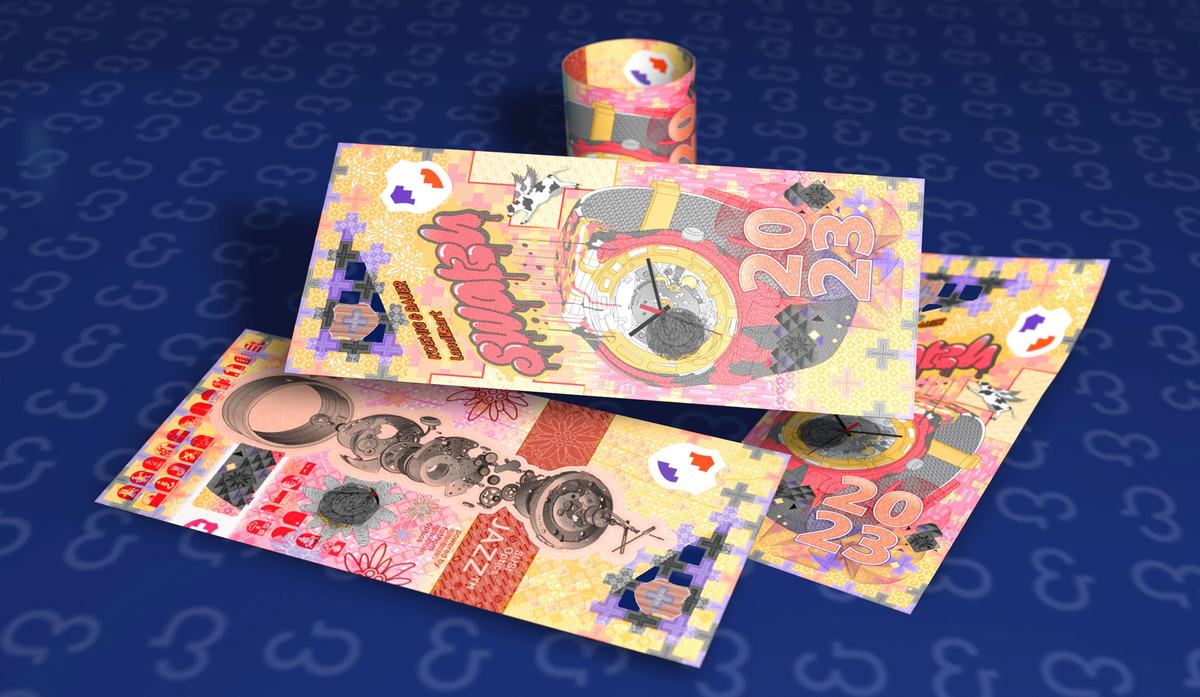
SUSI Optics® Jazz™, the latest addition to the SUSI Optics® family of optically variable features for banknotes, was launched at the Currency Conference in May, with a stunning specimen note produced to demonstrate the spectrum of opportunities it offers.

The specimen design and feature development project are a collective endeavour involving Koenig & Bauer Banknote Solutions (KBBS), the Swiss watch manufacturer Swatch, 3D effects specialist Fathom Optics and Landqart.

As is widely recognised, windows in banknotes are a security feature in their own right, but also provide a platform for a wide range of optically variable and other effects that in many cases can be viewed from either side of the note. Such effects, secure and eye-catching as they are, can also be expensive and complex to integrate.

SUSI is an acronym for Super Simultan, presses from KBBS allowing one-sided and two-sided printing in perfect register. SUSI Optics® is a family of optical effects printed using the ultra-high registration capability of SUSI presses, in combination with specific and custom-made origination techniques, sometimes combined with screen printing or application. A wide variety of advanced interactive effects can be created, including movement on the horizontal and/or vertical axis, 3D effects, the sensation of depth, colour shifts, the transformation of shapes, or any combination of these.

The feature design and effect are calculated via complex algorithms developed by Fathom Optics, specialists in the deployment of light field technology for special effects, including security.

Those calculations rely on a consistent focal length, which is provided by the thickness of the polymer layer being very carefully controlled. Then follows micron scale front-to-back registration through Simultan printing, and the precise pigment density of the offset inks.

The result is a unique visual appearance with fully customisable designs and a range of visually striking optical effects. These can include colour switch, 3D movement, morphing, and depth – all of which are generated through the highly secure and cost-effective medium of offset print without the use of lenses, holograms, foils or patches.

Having established that the feature worked well on the Durasafe® substrate, the challenge then was to create a specimen note to showcase the effects of SUSI Optics Jazz to their best advantage.

In keeping with the Jazz theme, it had to be something that would be out of the ordinary, but still recognisable as a note, ie. different, but still familiar.

‘We needed a design partner that embodied the ideas of continuous innovation, who was happy to stray away from the expected, and was happy to be provocative, in a positive way! It would also help if they were not part of our industry in order to bring a different perspective’, commented Richard Perera of Landqart, who presented the specimen at the Currency Conference.

KBBS and Landqart turned to the renowned watchmaker Swatch – a byword for creative design and ground breaking technology, and capable of being, by the standards of the banknote industry, very ‘edgy’. and, at times, slightly irreverent – for the concept design. Swatch jumped at the chance and within two weeks, came up with a number of possible designs, of which there was one stand out ‘out-of-the-box’ example, and that was the one chosen.

Central to the design is, unsurprisingly, a watch. In this case, one from Swatch’s System 51 mechanical collection custom-made for this note, and the design team at KBBS were able to build intricate, non-repeating patterns and improvisations around the design, while remaining true to the original concept.

These patterns and background designs were made up of the logos of Swatch, KBBS and Landqart, watch shapes, the Swiss cantonal coat-of-arms and various imprints of the Edelweiss (Switzerland’s national flower).

The note features three windows with Susi Optics Jazz, the key effect of which is the conversion of the image from an Edelweiss to the numeral 23 and back again, which happens simultaneously in the two lower windows. Only a short movement of the note is needed to generate the effect. It’s easily visualised, even in less-than-ideal light conditions.

But the really fun effect, said Richard, is when you tilt the note, the Edelweiss ‘jumps’ from the lower window to the higher, circular one, replacing part of the watch mechanism. There is just a fraction of a delay built into the movement to allow for it to be a sequential change, unique to the cutting-edge calculations created by the team at Fathom Optics.

‘We believe that the feature meets the basic objective of being eye-catching, easy to see and understand’, he said. ‘It makes people want to interact with the note, and it’s a lot of fun!’.

‘It also meets the secondary objective of creating collaboration between the partners in the project and giving each true ownership and value: the substrate maker, the press-maker, the ink maker, the designers, the originators and, of course, the customer, all have their roles to play as they come together and bring their input to create this fantastic feature for the public.’

Subscriber content

Read the full article

Full access to Currency News articles, newsletters and archives.

Sign Up to Currency News Weekly

Receive regular updates on the latest news and articles posted on our website.