
· 8 min read

The Caribbean – A Celebration of SAFEGUARD Polymer

Astrid Mitchell
Astrid Mitchell · Editor
The Caribbean – A Celebration of SAFEGUARD Polymer

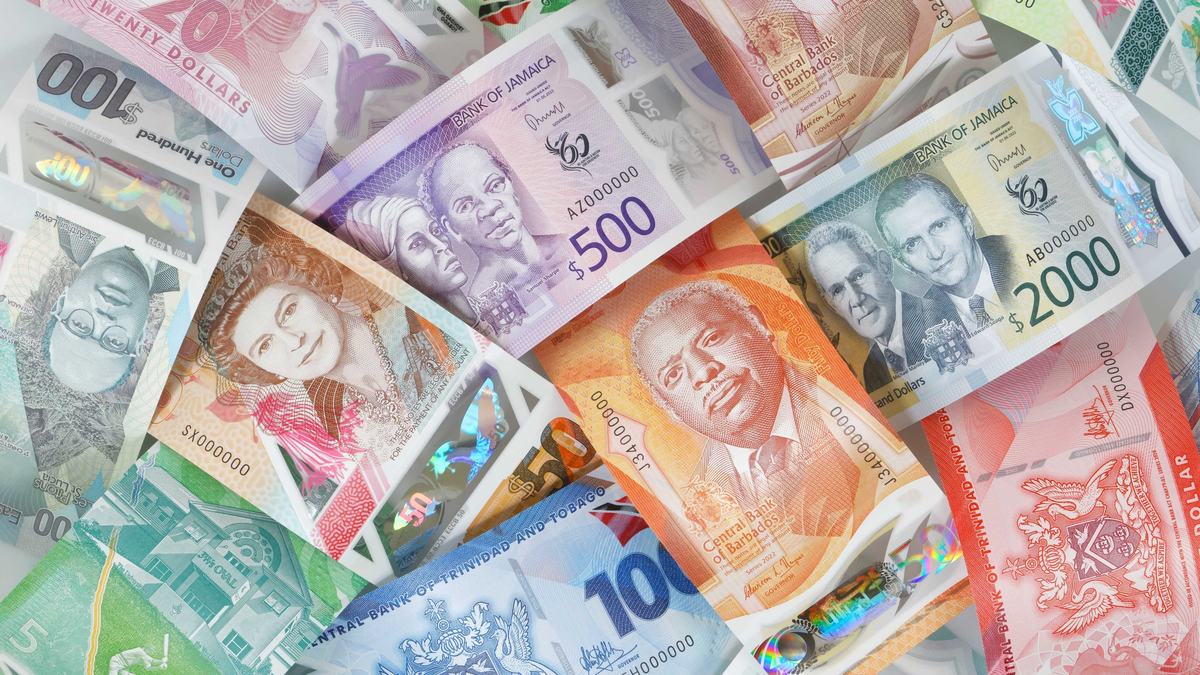
Over the course of the last four years, four currency series in the Caribbean have converted to polymer – starting with the East Caribbean dollar in 2019, followed by Trinidad and Tobago in 2020, then Barbados in 2022 and, most recently, Jamaica this summer.

At the High Security Printing (HSP) Latin America conference in the Bahamas in June, Gareth Evans of De La Rue – the supplier of the SAFEGUARD® substrate and the designer and printer for all four series – took delegates through the rationale, the implementation and the results to date of polymer in the region.

The Caribbean comprises 33 political entities (including 13 sovereign states, 12 dependencies and 7 overseas territories). Between them they cover an area of more than 240,000 km2 comprising 700 islands, islets, reefs and cays. The combined population is 44 million. There are 11 central banks with 10 national currencies and one common currency serving 18 of the states and territories. The others use the US dollar (or, in a couple of cases, the euro).

The four currencies that have recently converted to SAFEGUARD cover 11 countries, four central banks and 5.5 million people.

So what were the reasons underlying the change for so many central banks in rapid succession?

According to Gareth, the banknotes of each have historically been fairly traditional in design and in circulation for a long time with very few changes compared to other regions. Individually, each Bank decided it wanted more modern designs to reflect their vibrant culture, pay homage to their proud histories and look towards the future – complementing ongoing development and digitisation.

The East Caribbean Central Bank (ECCB) and Bank of Jamaica (BOJ), for example, have both invested in CBDCs with D-Cash and JamDex respectively, and are looking to reduce the reliance on physical cash. Both wanted modern, longer lasting and more cost-effective banknotes to complement this strategy.

All central banks wanted to stay one step ahead of the counterfeiter and all wanted more durable notes to ensure they stayed cleaner for longer and reduce replacement rates and overall costs.

Societal factors also play a bigger role in decision making.

For example, the International Agency for the Prevention of Blindness (IAPB) Vision Atlas study in 2020 estimated over 6 million people across the Caribbean suffer from vision loss. That’s around 13% of the population. There was a strong desire from each Bank to significantly improve the experience for these users.

The island nations of the Caribbean are also perhaps more acutely aware than most of the impact of climate change – experiencing more frequent and stronger adverse climate events such as hurricanes. So they are also actively demonstrating steps they are taking towards sustainability goals – a lower carbon footprint for cash and the ability to recycle banknote waste at the end of life being part of this.

Lastly there was a desire to ensure an element of flexibility and business continuity planning (BCP) in banknote procurement.

The Central Bank of Trinidad and Tobago (CBTT) wanted to reduce the annual cost of issuance and replacement. As one of the first central banks to issue a note on SAFEGUARD, back in 2014, they had collected data on its performance and evaluated it against other options. They had also been in a dialogue with representatives from the Blind Welfare Society for several years on how banknotes could be made more accessible for that community.

The Central Bank of Barbados (CBB) had been evaluating substrates and features over several years. In 2018 Senior Currency Officer Sharon Layne even completed a thesis on ‘the Cost and Life Cycle Analysis for Changing Barbados Banknotes to Polymer’ for her Masters’ Degree. CBB also spent time working with the Blind charity in Barbados to evaluate possible substrate and feature combinations to improve the notes for the visually impaired.

BOJ had used various durable coatings over the years to improve note life. They had also been using a composite substrate on the lowest two denominations since around 2012, so had first-hand experience of the procurement and performance of different durable solutions from different suppliers.

BOJ concluded a change was required to give them the ability to recycle their notes at the end of their life and to ensure competitive purchasing and business continuity in the future through multi-source supply.

BOJ also drew on the experience of other central banks and hired an independent industry consultant to assist them with their evaluation to ensure they selected a solution that met their key requirements.

So each Bank had a slightly different order of priorities, but the overall motives and requirements were fairly common, and they independently arrived at the same conclusion – new banknotes on polymer would best meet their requirements: 

  • More modern notes – the cleaner look of polymer and use of transparent windows

  • Cleaner for longer – through the non-porous nature of polymer

  • Fiscally responsible – increased note life on polymer would reduce replacement rates and overall cost

  • Enhanced security – incorporation of newer more secure features

  • Provide financial Inclusion for the visually impaired – through use of world leading tactile features

  • Meet sustainability goals – through lower lifetime emissions and fully recyclable substrate

  • BCP – polymer being available from more than one supplier.

Now the attention switched to perhaps the biggest concern in changing a banknote series – will the public accept them?

The evidence-based evaluations asked questions such as will it work in our climate, what’s the cost, when could we see a return on investment, who can supply it, what is the experience from elsewhere?

Emotional analysis

The questions now changed to emotional ones for the design process – how can we get the public to love it, what represents us as people, do we want a revolutionary or evolutionary approach to the themes, will the visually impaired be satisfied with what we do?

Once again, each Bank had individual desires, but a common strategy was evident.

For the ECCB, the new designs needed to be modern and fresh but retain a familiarity to previous notes to maximise recognition and public acceptance. A contemporary banknote design to complement the direction of the Bank and the introduction of a CBDC was wanted, and switching to a vertical design was chosen to give the notes a modern and fresh look.

The existing themes were retained but with refreshed imagery, while the images of hummingbirds and turtles from the previous notes were incorporated into new eye catching security features, immediately recognisable for the public.

There was an interesting discussion on the portrait of Queen Elizabeth II – whether to keep it, whether to upgrade it to a more recent image of an older queen. Ultimately, they decided to keep the youthful image of the queen (the design and issue pre-dated her death in 2022).

A key consideration was to give equal weighting in the design to all eight members of the East Caribbean Currency Union (Anguilla, Antigua and Barbuda, Dominica, Grenada, Montserrat, St Kitts and Nevis, St Lucia, St Vincent and the Grenadines) and not appear to show favouritism to one island over any other.

CBTT modernised their notes whilst maintaining consistency with their traditional banknote designs, such as the coat-of-arms taking centre stage alongside the national birds.

The two towers image of the central bank building were retained but included refreshed imagery depicting scenes of life around Trinidad and Tobago on the reverse to promote the theme of national identity.

And to help invoke a sense of pride, the nation’s iconic flag was now included on each note.

Although keeping the same predominant colour for each note, the new notes used a much stronger and bolder colour palette to reflect the vibrancy and diversity of life on the two islands that make up Trinidad and Tobago. The colours were chosen in collaboration with the Blind Welfare Association to improve the experience for visually impaired users. Large bold numerals completed this approach.

With Barbados, existing portraits and overall themes were again retained and refreshed. This series has been switched to a vertical orientation to give more prominence to those images on the notes.

The bulk of the design process occurred during COVID restrictions and the team from the Bank and De La Rue had to work together remotely for the most part. The backdrop of the pandemic actually helped drive the design story – it created a real sense of wanting to bring everyone together again back home in Barbados and this sense of national togetherness is brought out across the series.

When all six denominations are brought together the satellite image of Barbados is revealed across the entire series. Its outline illuminates under UV to add security to the artistry.

In a world first, the holographic Spotlight feature has been used in the windows to bring secure animation to the national symbols they depict.

Finally, the Bank of Jamaica wanted a fresh new look in a modern design to complement the issuance of its JamDex digital currency.

A key objective was to re-establish the prominence of Jamaica’s national heroes on the banknotes. Over the years as lower denominations have been demonetised some of Jamaica’s most iconic figures from history had dropped off the currency altogether and there was a strong desire to rectify this.

The result is a banknote series featuring dual portraits on five of the six denominations. Marcus Garvey is the exception, standing alone on the $100.

Not only are the dual portraits printed on the notes, but they also appear in the polymer windows of the low denominations and in photo-realistic holographic effects in the windows of the three high values, giving each note unique security and aesthetics.

Once again, a revitalised colour palette was used and the designs were tested with key stakeholders, including the visually impaired.

Results and public reaction

So what has the reception to the new series been like across the region? So far, extremely positive said Gareth.

It is too soon to accurately state the exact note life increase for each denomination. In order to know if a banknote will last five or ten years, they need to have been in circulation at least that long.

However, both the ECCB and CBTT have reported they have not had cause to remove significant volumes of unfit notes since 2019 and have already met their budgeted expectations for increased note life.

The response from the visually impaired communities across the region has been particularly rewarding for all involved in these projects. As has public acceptance, with each central bank making a great effort in their communications, both in advance and after their launches.

The Central Bank of Barbados was a finalist for the best public engagement programme at the recent IACA awards. One of their initiatives was the Roadrunner event. Early in the morning on the day the notes went into circulation central bank staff and a radio presenter want out in a minibus and showcased the notes in various locations – bus stations, market stalls and shops etc. The reaction was ‘fantastic’, and the hard work has evidently paid off, to the point where the public are now only asking for the new notes instead of the old cotton ones.

Industry recognition has also followed. The ECCB’s banknotes were named Best New Series at the HSP LatAm event in 2022, and the new Barbados series won the same award a year later. Several of the notes from across all four Banks have also been nominated for IACA and IBNS awards.

Subscriber content

Read the full article

Full access to Currency News articles, newsletters and archives.

Sign Up to Currency News Weekly

Receive regular updates on the latest news and articles posted on our website.